

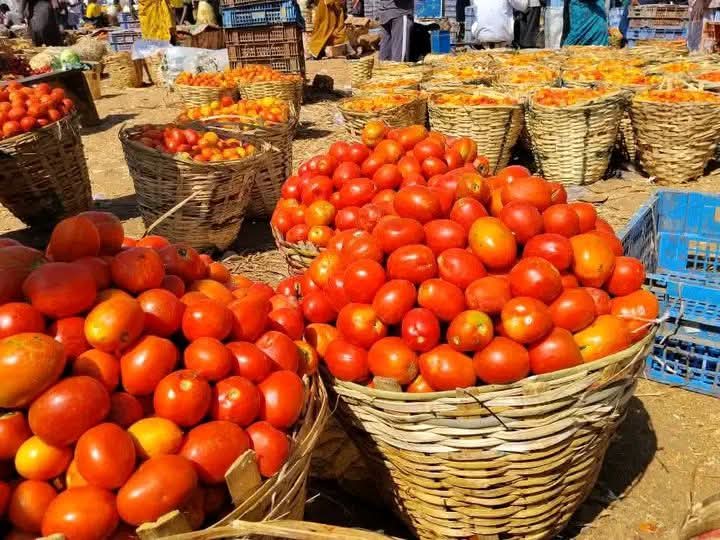
Tomato farmers across key producing states including Kano, Katsina, Kaduna, and Plateau are reeling from heavy financial losses as a sudden market glut has driven prices to rock-bottom levels at the start of the harvest season.
Following years of devastation caused by the destructive Tuta absoluta pest known as the tomato leaf miner which first struck in 2016 and affected northern states like Jigawa, Kano, Katsina, Kaduna, Plateau, Gombe, and Nasarawa, many farmers had borrowed loans and invested heavily to revive production with improved pest control measures. The renewed confidence led to increased cultivation this dry season, resulting in abundant yields that have overwhelmed markets.
In Kano, farmer Malam Abba Ibrahim Kalla of Bunkure Local Government Area described the struggle noting that despite recovering from last year’s pest-induced losses through associate loans, the surplus now threatens further hardship. Market visits revealed a full basket of tomatoes selling for less than N10,000 down from over N25,000 previously while crates fetch under N3,000, far below production costs for fertiliser, seeds, chemicals, labour, and transport.
Farmer Idris Muhammed noted the irony: “With improved pest control measures and renewed confidence, many farmers returned to tomato cultivation this season. Ironically, the rebound in production has now resulted in excess supply, outpacing market demand, resulting in the glut we are witnessing now.”
In Kaduna, Alhaji Auwal Ibrahim Hunkuyi of Hunkuyi town lamented soaring input costs: “Today, a bag of fertiliser is sold at N50,000, yet you end up selling tomatoes at N1,700 to N3,000 per kilogram. That alone shows that something is seriously wrong.” He added that many farm merely for survival, not profit: “If you spend N1 million on a farm, it is very difficult to make N200,000 profit… most times, you run at a loss.”
At Mugadishu Market in Kaduna, assistant chairman Hafiz Umar reported baskets at N10,000, rubber containers at N3,500–N4,000, and smaller portions at N500–N1,000—sharp declines from last year’s hot-season highs of N60,000–N100,000 per basket. He attributed better supply to the cold season reducing pests but warned of future scarcity without interventions.
In Plateau, market leader Ruth Izang cited prices as low as N3,000–N5,000 per basket, blaming influxes from Zaria and lingering diseases. Professor Juliana Mafuil confirmed ongoing Tuta absoluta attacks: “There are lots of Tuta Absoluta in many farms… many farms are still affected, big time.”
The crisis is worsened by absent cold storage, processing plants, and unreliable electricity, forcing farmers to dry produce or watch it rot. Stakeholders, including agricultural expert Alhaji Basheer Auwal, call for urgent government and private investment in processing, cold facilities, and export channels to break the boom-bust cycle.
HortiNigeria’s Mohammed Salasi Idris highlighted post-harvest losses discouraging investment, while initiatives like NIHORT’s tomato wine processing offer hope for value addition.
Minister of Agriculture Senator Abubakar Kyari outlined federal plans for $869 million investment targeting 72,000 hectares in Kano, Bauchi, and Borno to halve losses, boost yields to 30 tonnes per hectare, benefit 36,000 farmers directly, and create broader jobs.
Without sustained action on storage, disease control, and market stability, the sector risks further decline, threatening livelihoods and food security in Nigeria’s tomato belt.