
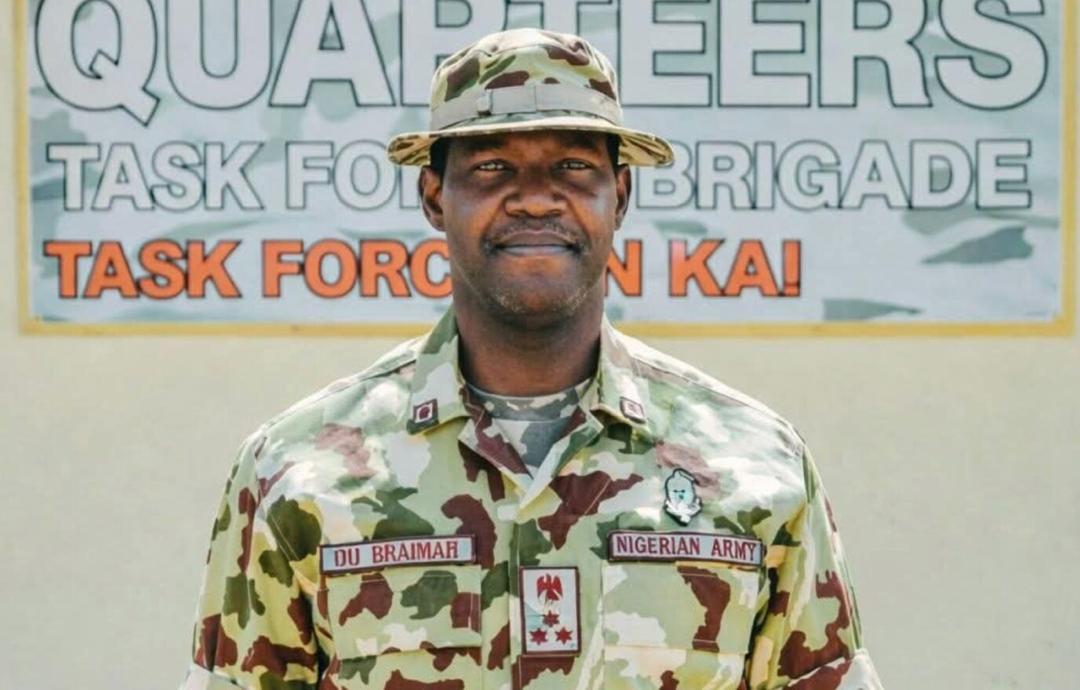
Fresh details have emerged on the circumstances surrounding the killing of the Commander of the 29 Task Force Brigade, Brigadier General Oseni Braimah, following a midnight assault on a military base in Benisheikh, Borno State.
Surviving soldiers described the incident as one of the fiercest attacks in recent months, with insurgents launching a coordinated offensive that overwhelmed troops despite official claims that the assault was repelled.
The attack occurred around 12:30 a.m. on Thursday, April 9, 2026, when suspected Boko Haram and Islamic State West Africa Province fighters struck multiple military positions in Benisheikh, a strategic town in Kaga Local Government Area along the Maiduguri–Damaturu highway.
Eyewitnesses said the attackers advanced in large numbers, hitting at least three military formations before pushing into civilian areas. A soldier who survived the assault said the scale and coordination were unprecedented.
“We are used to coordinated attacks, but this was different. They came in large numbers from different directions at the same time. It felt like they had studied our positions for weeks,” he said.
Another soldier admitted the attackers had a numerical advantage.
“We stood our ground at first, but they were too many. They attacked from different angles. It was like an ambush,” he said.
He added that morale dropped after reports spread that other positions had been overrun and that the brigade commander had been killed.
“When we started hearing that our colleagues in other locations had been overrun, it shook us. Then someone shouted that the Brigade Commander was dead. That was when fear fully set in,” he said.
Sources said the confusion and psychological impact of the attack led to a breakdown in coordination, forcing some troops to retreat into the town. The gun battle reportedly lasted over one hour and 30 minutes, with multiple explosions sending both soldiers and residents fleeing.
Braimah’s death
In the aftermath, claims emerged that the general died due to a malfunctioning Mine-Resistant Ambush Protected vehicle. However, military sources disputed the account, saying the vehicle was set ablaze during the attack.
“The insurgents actually set the MRAP on fire. Saying he died because the vehicle didn’t start is not accurate. The situation was far more complex,” a source said.
Another insider noted that only those present at the scene could give a full account, as many were killed during the encounter.
A former driver to the late general, identified as Blacky, described Braimah as diligent in maintaining operational vehicles, dismissing suggestions of negligence.
However, another source pointed to possible systemic lapses, alleging recurring issues with maintenance of operational equipment within the unit.
Civilian toll and destruction
Residents said the attack caused widespread panic, with many fleeing their homes amid heavy gunfire and explosions.
“We heard loud explosions and continuous gunshots. It was terrifying. People were running in all directions. Even soldiers ran into the town for cover,” a resident, Mustapha Abu, said.
Several civilian properties, including shops and vehicles, were destroyed, while travellers stranded due to the routine closure of the Maiduguri–Damaturu road abandoned their vehicles and fled.
Sources said the temporary withdrawal of troops created a security gap, allowing insurgents to loot military facilities and inflict further damage.
Army responds
The Headquarters of Operation Hadin Kai dismissed reports of heavy casualties, including claims that 17 soldiers were killed.
In a statement on Friday, April 10, 2026, the Media Information Officer of the Northeast Joint Task Force, Lt.-Col. Sani Uba, said only two officers and two soldiers died in the engagement.
He also rejected claims that the brigade commander’s vehicle was unserviceable, stating that it was only temporarily immobilised during the battle as the general coordinated counter-operations.
Uba maintained that troops successfully repelled the attack and forced the insurgents into retreat, warning against the spread of misinformation aimed at undermining military operations.
A troubling pattern
The killing of Brigadier General Braimah adds to a growing list of senior military officers lost in the insurgency in the North-East, raising concerns over operational strategy and force protection.
Several high-ranking officers, including Brigadier Generals Musa Uba and Dzarma Zirkusu, as well as other senior commanders, have been killed in similar attacks in recent years.
Tinubu reacts
President Bola Tinubu has expressed sorrow over the killing of the officers, commending troops for their bravery.
In a statement issued by his Special Adviser on Information and Strategy, Bayo Onanuga, the President said the military had continued to record gains against insurgents despite recent attacks.
“The insurgents’ counterattack is a sign of desperation,” Tinubu said, urging troops not to be discouraged.
He extended condolences to the families of the fallen soldiers and reaffirmed the Federal Government’s commitment to defeating terrorism and restoring peace across the country.