
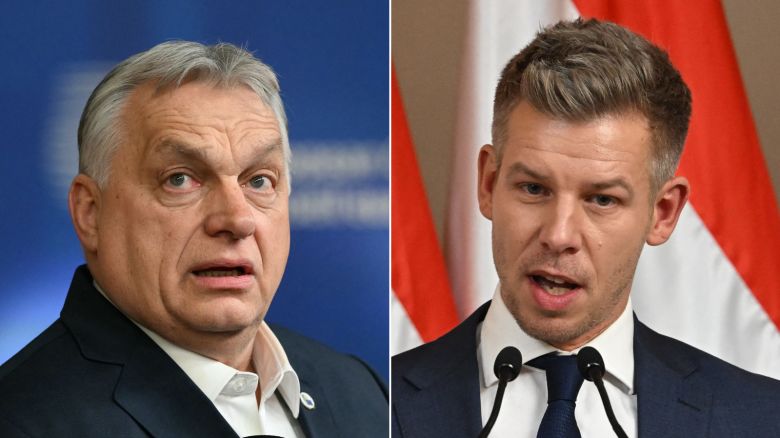
Hungary’s long-serving prime minister, Viktor Orbán, has conceded defeat in a closely watched national election, bringing an end to his 16-year hold on power and marking a significant political shift in central Europe.
According to CBC News, Mr Orbán, Speaking to supporters late on Sunday, described the result as a “painful” loss, acknowledging victory for his challenger, Péter Magyar, whose campaign centred on tackling corruption and restoring ties with Western allies.
“I congratulated the victorious party,” Mr Orbán said. “We will continue to serve the Hungarian nation from the opposition.”
With the vast majority of votes counted, Mr Magyar’s Tisza party secured a clear lead, gaining more than half of the popular vote and outperforming Mr Orbán’s Fidesz party by a wide margin. Early projections suggested Tisza was on course to win a commanding number of parliamentary districts, though it remains uncertain whether it will secure the two-thirds majority required to govern alone.
The result follows a record turnout, reflecting strong public engagement in what many voters viewed as a defining moment for the country’s future direction.
Addressing thousands of supporters gathered along the Danube in Budapest, Mr Magyar framed the outcome as a historic reset.
“Tonight, truth prevailed over lies,” he said. “Hungarians have shown what they are capable of when they act for their homeland.”
His victory is widely seen as a turning point for Hungary’s domestic and foreign policy. He has pledged to rebuild relations with the European Union and NATO, both of which became increasingly strained under Mr Orbán’s leadership.
European leaders were quick to offer their congratulations, signalling readiness to work with the incoming administration.
Mr Orbán, one of Europe’s longest-serving leaders, has been a dominant figure in Hungarian politics since returning to power in 2010. Over the years, he reshaped the country’s political landscape, promoting what he described as an “illiberal democracy” while drawing criticism from EU partners over media freedoms, judicial independence and minority rights.
Internationally, he cultivated close ties with figures such as former US president Donald Trump and Russian leader Vladimir Putin, positioning Hungary as a key voice within the global conservative movement.
However, his government also faced growing domestic dissatisfaction, with many Hungarians citing rising living costs, economic stagnation and concerns over corruption among political elites.
For many voters, the election represented a broader choice about Hungary’s identity and direction.
“This was about whether we belong to a Western-style democracy or move closer to an Eastern model,” said one young voter in Budapest, reflecting a sentiment echoed across the capital.
Others pointed to frustration built over years. Some former supporters of Mr Orbán joined celebrations, saying their hopes for reform had faded over time.
Crowds at victory gatherings waved Hungarian and EU flags, with some chanting slogans calling for greater distance from Moscow.
In his victory speech, Mr Magyar struck a conciliatory tone, urging Hungarians to move beyond political divisions after a tense campaign.
“This is a day for reunification,” he said. “We cannot remain divided. We must rebuild together.”
After more than a decade and a half under one of Europe’s most influential and controversial leaders, Hungary now enters a new political chapter—one that could reshape not only its domestic policies but also its role within Europe and beyond.