

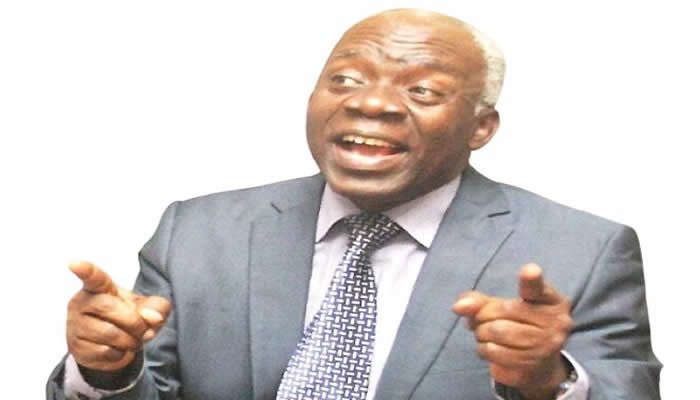
Human rights lawyer and Senior Advocate of Nigeria, Femi Falana, has urged residents of Lagos State to disregard any restriction of movement during the monthly environmental sanitation exercise, insisting there is no law backing such limitations.
Falana maintained that residents are free to go about their normal activities, stressing that the exercise does not legally mandate people to remain indoors.
His position comes amid renewed enforcement of the sanitation programme by the state government, which on Friday, April 24, 2026, reaffirmed that the exercise remains valid and will proceed as scheduled. Authorities directed residents to stay at home and participate fully between 6:30am and 8:30am on Saturday, April 25, 2026.
In a statement posted on X on Friday, April 24, 2026, the Commissioner for the Environment and Water Resources, Tokunbo Wahab, dismissed claims that a court ruling had halted the programme.
“No court pronouncement has invalidated this exercise. The state proceeded to the Court of Appeal, and judgment was delivered in our favour. The court affirmed that the laws used for the implementation and enforcement of environmental sanitation are legitimate and constitutional,” Wahab said.
He urged residents to ignore what he described as misinformation regarding the legality of the exercise.
The reintroduction of the monthly sanitation exercise was announced on March 14, 2026, by Governor Babajide Sanwo-Olu, who led top government officials, including Deputy Governor Obafemi Hamzat, on a monitoring and clean-up exercise at Agege Motor Road, Mushin.
However, Falana criticised the move to enforce movement restrictions during the exercise, describing it as unconstitutional and inconsistent with an existing court judgment.
Speaking with Saturday PUNCH, Falana said available information indicated that the state had not formally reintroduced compulsory sanitation with enforced movement restrictions.
“From the information at my disposal, the Lagos State Government has not reintroduced compulsory monthly sanitation exercise. To that extent, residents are at liberty to carry on their legitimate business during the sanitation exercise, as the government has not restricted their movement in any manner whatsoever.
“For the avoidance of doubt, the restriction of movement is voluntary and not compulsory,” he said.
He noted that while the government encourages residents to clean their surroundings during the exercise, participation should not infringe on citizens’ rights.
Falana also urged residents to cooperate with officials of the Lagos State Waste Management Authority in ensuring proper waste collection and disposal across the state.
He argued that Lagos should move away from policies rooted in military-era practices, particularly those that restrict freedom of movement.
“The Lagos State Government cannot afford to continue with the military legacy of restricting the movement of citizens,” he said.
Falana added that the government’s commitment to environmental management is evident in its fiscal priorities, noting that N236bn was allocated in the 2026 budget for waste management, drainage expansion, and environmental protection.