

Lucky Obukohwo, Reporting
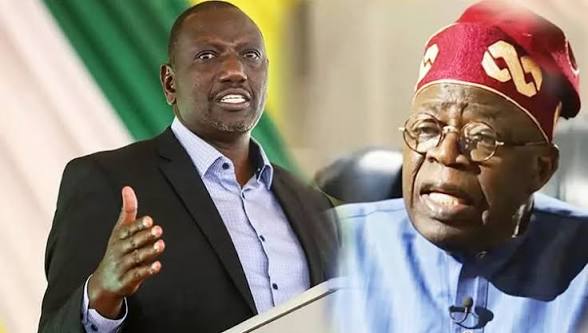
Kenyan President William Ruto has has shed light on his recent comments on Nigerian English, saying that he was quoted out of proportion and did not reflect any slight against Nigerians
Speaking at the Mining Investment Conference and Expo in Nairobi, the Kenyan leader said the remarks were made in what was intended to be a private conversation before they found their way into the public space.
“Please pass my regards, Minister, to President Tinubu, my friend, and to the great people of Nigeria, who are my in-laws, and do so in good English,” Ruto said.
He explained that his comments were aimed at highlighting the strong command of English across African countries, not ridiculing Nigeria.
“The facts are that I was talking about how we in Africa speak very good English, all of us,” he said.
Ruto stressed that Nigeria was, in fact, central to the point he was making about linguistic excellence on the continent.
“In some countries like Nigeria, if you don’t speak excellent English, like the one we speak in Kenya, you may need a translator for you to understand the excellent English of Nigeria.”
He said the backlash emanated from a distorted interpretation of his words.
“But somebody decided to take it out of context. And my in-laws, I hope there will be no consequences for whatever was done,” he added.
Truth Live News Media reports that the remarks, was made by Ruto while addressing Kenyans in Italy around April 20-23, 2026, were he intended to praise Kenya’s education system, but were widely interpreted as demeaning to Nigeria.
His words, “If you listen to a Nigerian speaking, you don’t know what they are saying – you need a translator even when they are speaking English”.
The comment was seen as a “lighthearted jab” or a “clapback” to earlier remarks by Nigerian President Bola Tinubu, who had suggested Nigerians were better off economically than Kenyans.
The comments generated a “cyber war” on social media platform X (formerly Twitter) between Kenyans and Nigerians, with many criticizing the remarks as demeaning to a fellow African nation.
Some supporters argued that the comments were intended as humor, banter, or a “friendly jab” between nations.