
Politics, at its highest and noblest level, is not supposed to be an endless recycling of sentiments, provincial anxieties, manufactured indignation, and pedestrian arguments disguised as strategy. It is supposed to be about the future. It is supposed to be about capacity. It is supposed to be about who possesses the energy, intellect, exposure, temperament, and legislative depth to move a people forward at a particular point in history.
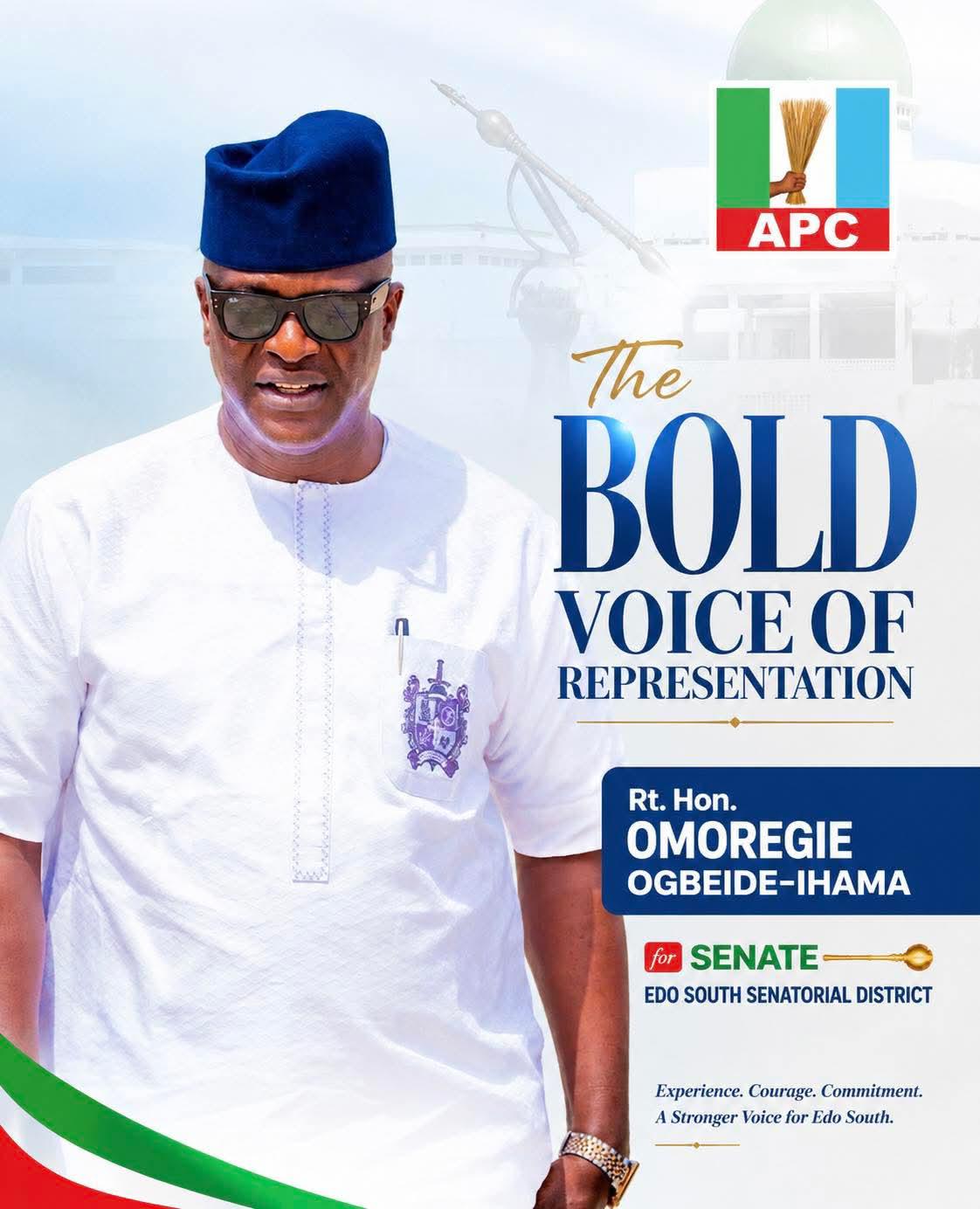
That is why, after careful reflection and observation, I have come to the firm conclusion that Engr. Omoregie Ogbeide-Ihama represents one of the finest possibilities presently available to the Edo South Senatorial District.
This position is not emotional. It is not transactional. It is not borne out of bitterness toward anyone. It is an honest political conclusion founded on reason, political reality, generational necessity, and strategic foresight.
I say this, particularly aware that Distinguished Pastor Osagie Ize-Iyamu was once my political leader in the APC before my movement to the PDP, where I later had the privilege of serving as spokesman to Asue Ighodalo and, eventually, as Publicity Secretary of the PDP in Edo State, before my resignation earlier this year. I therefore understand the sensitivities involved. But politics must never imprison the mind. Leadership demands the courage to make objective judgments, even where emotions, history, or former affiliations tempt silence.
Engr. Omoregie Ogbeide-Ihama embodies what Edo South desperately needs at this moment: the convergence of youthfulness, education, professional exposure, political experience, and legislative maturity.
Too often in our political environment, we make the tragic mistake of treating leadership as though it were merely an inheritance system regulated by seniority and perpetual entitlement. The world has moved beyond that. Modern governance increasingly rewards agility, intellect, adaptability, communication skills, policy understanding, and the stamina to engage a rapidly evolving society. The Senate today is no longer merely a retirement chamber for political elders. It is an arena requiring intellectual mobility, strategic sophistication, media awareness, national relationships, and legislative competence.
Ogbeide-Ihama comes into this conversation with all these attributes.
He is educated. He possesses technical and professional grounding as an engineer with additional exposure in oil and gas administration.
More importantly, he is not entering legislative politics as an apprentice. He has already undergone the rigorous baptism of parliamentary engagement as a two-term member of the House of Representatives. And that fact is profoundly important.
People must understand what it means politically to represent Oredo Federal Constituency twice.
Oredo is not politically docile. It is not one of those constituencies where electoral outcomes are determined merely by emotional attachment or primitive loyalty structures. It is sophisticated, highly opinionated, politically alert, and historically difficult to dominate repeatedly. The fact that Ogbeide-Ihama broke that pattern and secured two terms is not accidental. It means he earned trust. It means he demonstrated capacity. It means the people assessed him and renewed him.
That is political validation.
Indeed, one of the strongest arguments in his favour is precisely that he has already faced electoral scrutiny at a high level and survived it successfully.
Unfortunately, as often happens in our politics, weak arguments have now emerged to resist what appears to be an increasingly organic momentum around his aspiration.
One of such arguments is the tired provincial claim that Oredo has allegedly produced “too many senators.”
Frankly, I find that argument deeply unfortunate, self-serving, and intellectually pedestrian.
Benin people are one people. We are one nation under God and under our revered Oba. We share one ancestry, one historical civilisation, one cultural destiny, and one collective future. The attempt to reduce the Benin political question to narrow provincial calculations is dangerous and fundamentally inconsistent with the very essence of Benin history itself.
Indeed, historically speaking, every Benin indigene traces ancestral and civilisational roots to Oredo.
The old Benin Kingdom was never built around these modern political insecurities now being weaponised for temporary advantage. What mattered was service, capacity, loyalty to the kingdom, and collective advancement.
A senator is not elected to represent a village against another village. A senator is elected to advance the interests of Edo South as a whole.
The moment we descend into these narrow internal competitions disguised as justice, we weaken ourselves politically before outsiders who are far more united and strategic in pursuing power.
Even more amusing is the recent complaint from certain quarters that Ogbeide-Ihama is allegedly receiving support from non-Benin political interests.
I find the outrage selective and profoundly dishonest.
Politicians across Nigeria seek alliances, endorsements, and strategic support from every possible direction. Those making these allegations today also actively sought support from non-Benin interests, external political leaders, national power brokers, and broader party structures when it suited their ambitions, which they got at the time but could not properly manage . They had no moral discomfort then.
Politics has never operated in isolation. No serious political actor builds power by remaining confined within a narrow emotional enclave. Strategic relationships are part of democratic politics everywhere in the world. Where a candidate gets support should not be the business of political gossips masquerading as custodians of ethnic purity.
What should matter is simple: who possesses the competence, exposure, and legislative preparedness to serve Edo South effectively?
Even more bizarre is the sudden moral outrage against what some now call “imposition.”
The indignation is laughably selective.
Many of those now preaching against so-called imposition were themselves beneficiaries of structured endorsements, institutional backing, political machinery, and the influence of super leaders at various times in their political journeys. At the time, they did not consider it oppression. They called it leadership, consensus, party supremacy, strategic alignment, or political wisdom.
What has suddenly changed?
Politics everywhere involves persuasion, coalition-building, influence, alignment, negotiation, and structured support. No serious political system operates in a vacuum devoid of power blocs and leadership influence. The hypocrisy lies in condemning today what one celebrated yesterday merely because the equations no lon…