
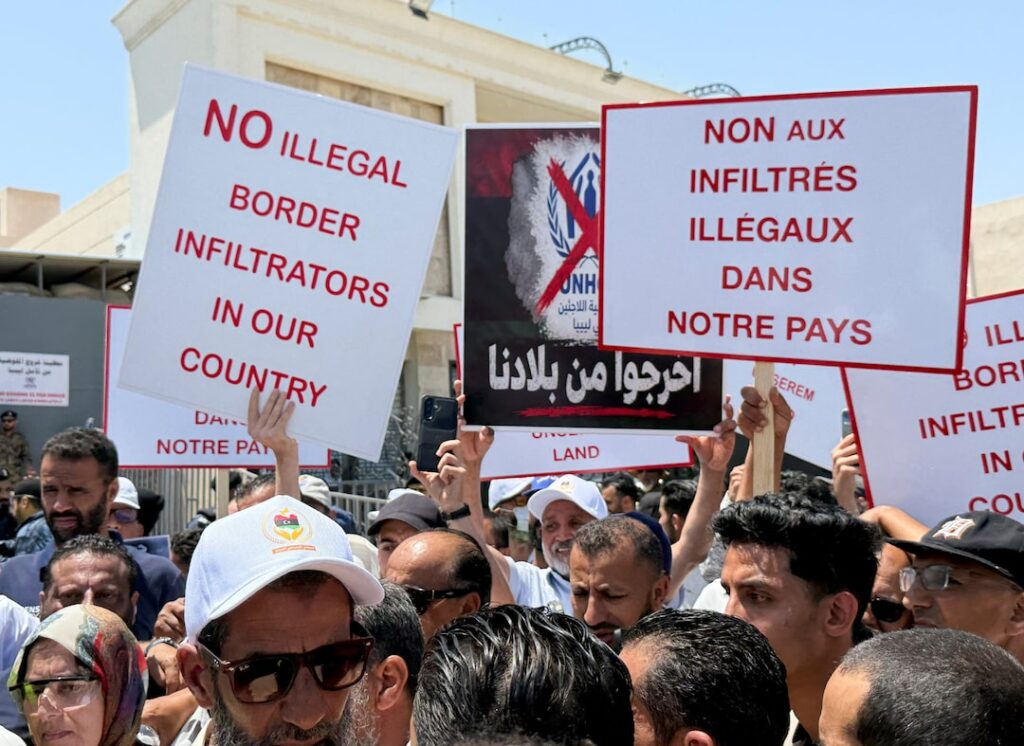
Hundreds of protesters gathered in Libya’s capital, Tripoli, on Thursday to demonstrate against the growing presence of migrants in the country, blocking access to the office of the United Nations refugee agency (UNHCR).
The protesters assembled outside the agency’s headquarters in the Sarraj district, carrying banners and chanting slogans demanding the removal of migrants and opposing any plans that could lead to their long-term settlement in Libya.
During the demonstration, participants erected temporary tents and used a truckload of sand to obstruct the main entrance to the UNHCR building. Many argued that the country is struggling to cope with the increasing number of migrants arriving from other African nations.
Libya has become a major transit point for migrants seeking employment opportunities or attempting to reach Europe since political instability intensified following the 2011 uprising. The country also attracts workers looking for jobs in sectors such as construction, sanitation, and other labour-intensive industries.
Thursday’s gathering was one of the largest anti-migrant protests seen in recent months. Some residents blame rising migrant numbers for worsening social and economic challenges, while others express concerns about security and pressure on public services.
Following the protest at the refugee agency’s office, some demonstrators reportedly moved toward the premises of the United Nations Support Mission in Libya.
In response, the UN mission reaffirmed the right of citizens to peaceful protest but condemned any threats or acts of hostility directed at UN personnel or facilities. Officials also rejected claims that the United Nations is operating a programme aimed at permanently settling migrants in Libya.
The UN explained that its refugee agency primarily assists people fleeing conflict and persecution by facilitating voluntary returns when possible or arranging relocation to third countries where appropriate.
According to international estimates, Libya hosts more than 900,000 migrants despite having a population of roughly seven million people.
Meanwhile, Libya’s acting foreign minister, Taher al-Baour, recently stated that there is no government-backed initiative to permanently settle migrants in the country. He acknowledged that Libya faces significant challenges managing migration flows but urged citizens not to attribute all of the nation’s political and security difficulties to migrants alone.
The demonstration highlights growing public debate in Libya over migration, border management, and the country’s capacity to accommodate large numbers of foreign nationals amid ongoing political and economic pressures.