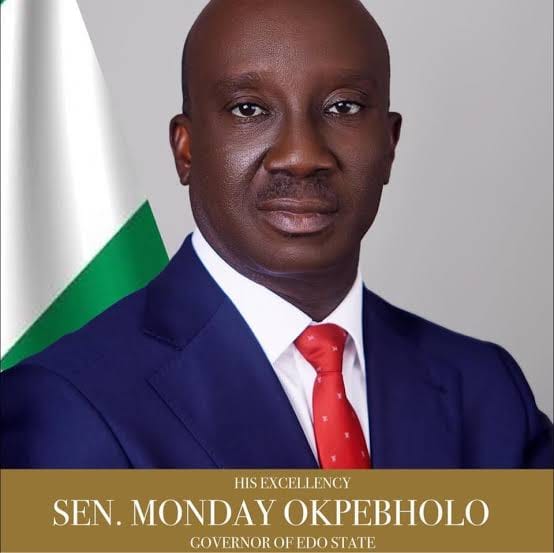

Suddenly, Nigeria’s social media Pharisees have discovered political appointments.
Since Governor Monday Okpebholo announced the appointment of 25 Special Assistants from each of Edo State’s 192 wards, giving a total of 4,800 persons, social media has erupted with predictable outrage. The number is paraded without context, accompanied by the familiar lamentations about waste, patronage and the cost of governance.
Fair enough. Government must always be interrogated.
However, facts must also interrogate hypocrisy.
Governor Okpebholo has explained precisely what he intends to achieve. His administration says the appointments are designed to deepen government’s presence at ward level, broaden grassroots participation and ensure that development, opportunities and government programmes do not terminate within the comfortable precincts of Government House, but travel down to the communities where the people actually live.
In the Governor’s own words, governance must move from “the top” to “the bottom”.
One may legitimately debate 25 persons per ward against the eighteen to eighteen persons per ward that eventually characterised the last administration. One may question the cost, interrogate their functions and demand measurable deliverables. Those are legitimate democratic enquiries. What is intellectually dishonest is pretending that ward-based political appointments are some bizarre contraption invented by Monday Okpebholo.
History has an inconvenient witness.
His name is Godwin Obaseki.
On 2nd June 2017, Governor Godwin Obaseki appointed 192 Special Assistants, one from EACH of Edo State’s 192 electoral wards.
His government called it “inclusive and participatory governance.”
The appointees were to operate from the wards, channel information to government and serve as its eyes, ears and mouthpiece at the grassroots. Obaseki explained that the arrangement was intended to address marginalisation and inequality so that no ward would complain that it had no voice in government.
Sound familiar?
If appointing government representatives at ward level was “inclusive and participatory governance” under Obaseki, by what intellectual alchemy has the same principle suddenly become an abomination under Okpebholo?
The historical record becomes even more inconvenient.
The original one-SA-per-ward arrangement did not remain the full extent of Obaseki’s political appointment architecture. By the twilight of his administration, multiple SSAs and SAs operated in individual wards. There were also liaison officers across the 18 local governments and Special Advisers with geographically defined responsibilities by federal constituencies and senatorial districts.
I know this beyond newspaper reports. When I joined the PDP in 2024, my Ward 2 in Uhunmwode, a relatively small ward of ten units, had eight SSAs and SAs. Larger wards such as Wards 5 and 6 had at least sixteen. Ward 9 also had around sixteen.
The published records tell the same broader story. In December 2021 alone, Obaseki appointed 38 SSAs and 96 SAs. In October 2023, another 34 SSAs and 152 SAs were appointed from just five Edo South local governments. Another 54 SAs and SSAs subsequently followed in Owan East and Owan West.
In the final analysis, by July 2024, Godwin Obaseki had not less than 2500 Special Advisers, Senior Special Assistants and Special Assistants all over the state, putting it conservatively!
Where, pray, were today’s newly converted apostles of lean government?
The hypocrisy becomes even more fascinating when one travels beyond Edo.
Enter Saint Peter Obi.
No contemporary Nigerian politician is more routinely presented on social media as the patron saint of governmental austerity. Yet the attempt to portray political aides as something alien to Peter Obi’s supposedly austere model of government collapses under the weight of history.
Peter Obi governed Anambra with Special Assistants, Senior Special Assistants and Special Advisers. Contemporary reports record that in 2007 alone, he disengaged 130 aides from his administration.
Pause there.
A government had enough political aides to disengage 130 of them in one fell swoop.
This does not make Peter Obi a bad governor. Neither does Obaseki’s appointment of a large number of political aides prove that he was profligate.
That is precisely the point.
So, when exactly did political appointments become evidence of profligacy? Was it only when Monday Okpebholo made them?
Apparently, political aides themselves were never the sin. The sin, it would seem, is that Monday Okpebholo is the Governor appointing them.
Numbers alone cannot constitute proof of bad governance. The intelligent questions are different: What are these appointees expected to do? What do they cost? What value will they deliver? Are they accountable? Will they create the long-awaited synergy between government and the governed?
Governor Okpebholo has offered his answer: take governance, participation and opportunities down to the grassroots.
Edo people should therefore hold these 4,800 appointees firmly to that mandate. They must become functional bridges between Government House and their communities; listening posts through which government can feel the pulse of even the remotest communities. They must not become decorative titles on complimentary cards.
Edo people must equally insist that the selection process is credible. The opportunity must not be hijacked by political leaders to reward girlfriends, cronies and moribund hangers-on, as was sometimes alleged under the previous administration. If this is grassroots inclusion, then the grassroots must actually be included.
Criticism is indispensable to democracy. Selective amnesia is not.
If ward-based appointments represented inclusive governance under Godwin Obaseki, and political aides populated Peter Obi’s famously “frugal” administration, political appointments did not suddenly become an economic crime on 10th August 2026.
Let us debate the policy.
Let us interrogate its implementation.
Let us also dispense with the hypocrisy.
Daniel Aroren Noah Osa-Ogbegie is a legal practitioner and thought leader based in Benin City.