
As an investigative journalist who has followed Nigeria’s political development for decades, I have watched successive governments confront coups, economic crises, militancy, insurgency, communal conflicts and organised crime.
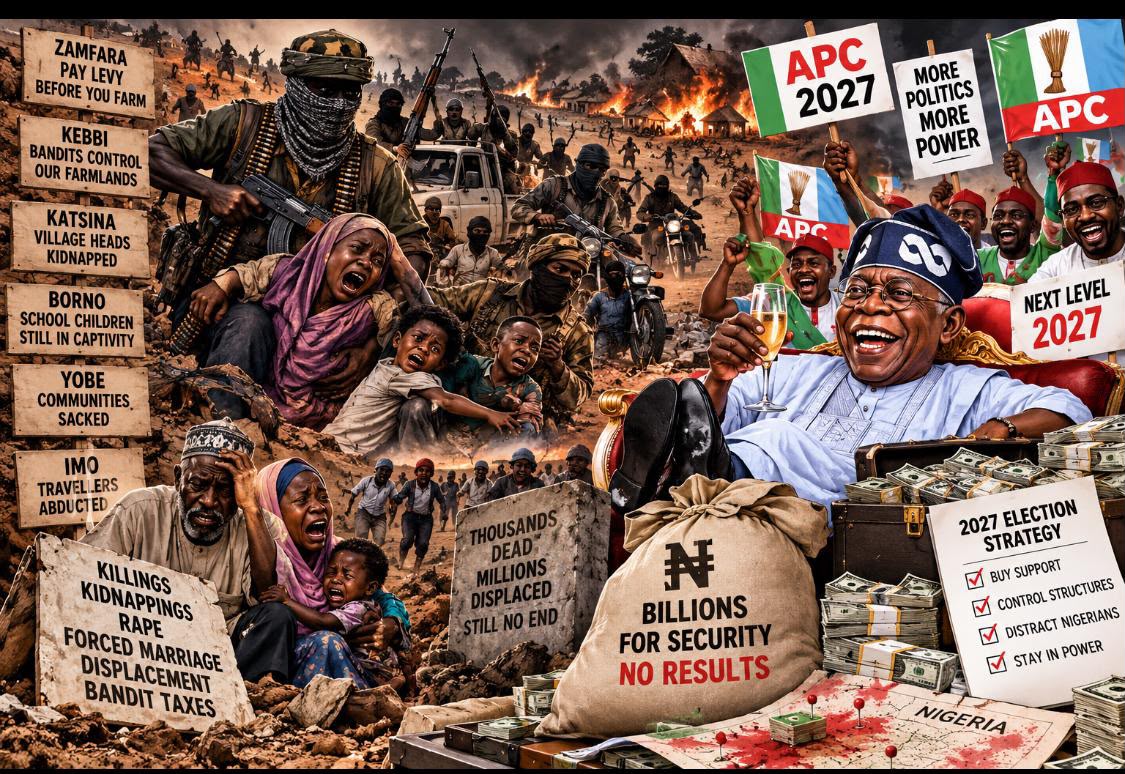
But as Nigeria marks 66 years of independence, the security situation confronting ordinary citizens demands much more than political rhetoric. From communities in the North-East and North-West to highways and campuses in the South-East, Nigerians are being killed, abducted and displaced with disturbing regularity.
What I have observed and investigated, alongside independently documented evidence, raises serious questions about the effectiveness of the security strategy of President Bola Ahmed Tinubu’s administration.
The figures are deeply troubling. In May 2026, a coalition of more than 50 civil-society organisations, drawing on the Mass Atrocities Tracker, reported that at least 19,980 people had been killed and 12,362 abducted in incidents of mass atrocities and violent attacks since Tinubu assumed office on 29 May 2023.
The coalition also reported that 1,486 security personnel had been killed in active service.
Amnesty International had earlier documented at least 10,217 killings in just seven states during the administration’s first two years, including 6,896 in Benue and 2,630 in Plateau.
These datasets use different methodologies and should not simply be added together, but each points independently to a grave security emergency.
It would be historically difficult to prove that this is literally Nigeria’s “worst insecurity since 1960,” particularly because Nigeria fought a civil war between 1967 and 1970 and reliable, comparable nationwide datasets do not exist across the entire 66-year period. What can responsibly be said is that Nigeria is experiencing one of the gravest and most geographically dispersed security crises of its post-civil-war history.
Unlike a conventional war with a clearly defined front, today’s violence stretches across insurgency in the North-East, banditry and mass kidnapping in the North-West, communal and armed-group violence in the Middle Belt, and kidnapping and other armed violence in southern states.
Human Rights Watch described killings, kidnappings and violent raids as continuing across several regions, while ACLED has documented persistent and evolving armed violence.
Kidnapping has effectively developed into an underground economy. SBM Intelligence recorded 7,568 abductees in 1,130 incidents between July 2023 and June 2024, with kidnappers demanding nearly ₦11 billion. Between July 2024 and June 2025, another 4,722 people were abducted in 997 incidents, according to SBM data cited by Premium Times.
Most disturbing is the latest cycle: between July 2025 and June 2026, SBM recorded 7,825 abductees across 1,713 kidnap and kidnap-related incidents, with at least 1,142 people killed. Ransom payments during that latest period reached approximately ₦7.78 billion*l. These are reported cases; the true human cost may be higher.
Then there are the children of Borno. As Nigeria celebrated independence, 78 schoolchildren remained in captivity following abductions from communities in Askira-Uba. The Christian Association of Nigeria in Borno publicly appealed for their rescue only days before the Independence anniversary, saying some had spent more than 100 days in captivity.
A proof-of-life video had earlier emerged concerning children abducted from Government Day Secondary School, Lassa. These are Nigerian children whose families have lived through months of uncertainty, yet they received no specific mention in the President’s October 1 address.
Even as Nigerians were digesting that Independence Day message, another frightening report emerged from Imo State. On the Owerri-On it sha Expressway, gunmen attacked two buses carrying young Nigerians travelling to NYSC orientation camps.
BBC reported on October 2 that up to 19 people, most of them prospective corps members, were abducted, with Imo police confirming awareness of the incident and saying rescue operations were underway.
Only weeks earlier, a bank branch manager had been killed during an attack at the Federal University of Technology, Owerri, while two female students were reportedly abducted. When young graduates answering the national call to service cannot travel safely to orientation camp, the symbolism is difficult to ignore.
Zamfara presents another disturbing picture. Amnesty International documented 273 people killed and 467 abducted in Zamfara between May 2023 and May 2025, while reporting that hundreds of villages had been sacked or were under the influence of armed groups.
More recently, gunmen invaded Tsafe and abducted five residents, including women. In September, the Army also confirmed the abduction of Islamic scholars travelling from the Sububu forest axis.
The chairman of Bungudu Local Government, Nura Abdullahi, was himself abducted in July and spent 61 days in captivity before regaining his freedom. If elected local officials can be taken from their communities and held for two months, the vulnerability of ordinary villagers requires no exaggeration.
Perhaps nothing illustrates the erosion of state authority more painfully than the emergence of what communities describe as “farming taxes.” Investigations and reports from northern Nigeria have documented farmers paying armed groups before being permitted to enter their own farmlands. In Katsina, residents of Kwandawa were reportedly confronted with a ₦20 million levy; communities elsewhere have faced similar demands. Nigerian Tribune reported in August 2026 that farmers in states including Zamfara, Katsina, Sokoto, Yobe and Kebbi had either lost access to farmland or were paying levies imposed by armed groups. HumAngle separately documented Zamfara farmers paying millions to armed groups and still facing displacement. This is no longer simply kidnapping: where verified, it amounts to non-state armed actors exercising coercive economic power over Nigerian territory.
Behind these statistics are atrocities against women and girls that should never become normalised. Amnesty International has documented the experiences of girls and young women abducted by Boko Haram, forcibly married, subjected to domestic servitude and sexual violence, including rape and forced pregnancy. In interviews with survivors, Amnesty found that many continued to struggle without adequate reintegration and specialist support even after escaping captivity. These abuses predate the current administration, but the continuing obligation to protect vulnerable communities, rescue captives and rehabilitate survivors belongs to the government of the day.
The collapse of security in some rural communities has also weakened traditional structures that once represented the nearest form of authority to the people. Armed groups have threatened community leaders, attacked settlements and imposed levies backed by threats of killing, abduction or expulsion. The European Union Agency for Asylum, drawing on multiple sources, reported that armed groups in Zamfara have pressured civilians to pay taxes through threats to kill, abduct, injure or forcibly evict them. This creates an intolerable situation in which some Nigerians must negotiate with armed men for the elementary rights to live in their villages, cultivate their farms and move freely.
This is happening despite enormous public expenditure on security. President Tinubu’s own 2025 budget presentation proposed ₦4.91 trillion for defence and security, while at the signing of the final 2025 budget the Presidency described ₦6.11 trillion as the national-security allocation. For 2026, the President’s budget speech identified another ₦5.41 trillion for defence and security. The administration says these funds support military modernisation, intelligence-led policing, border security, surveillance and improved fighting capability. The legitimate investigative question, therefore, is not whether money is being allocated, but whether Nigerians are receiving security outcomes proportionate to the unprecedented resources committed.
That question became even more compelling after President Tinubu’s October 1 Independence Day address. To be accurate, the President did mention insecurity generally and thanked members of the Armed Forces and security services for putting themselves in harm’s way. But the published speech did not specifically address the ongoing mass abductions, the 78 Borno schoolchildren still reported in captivity, the families awaiting kidnapped relatives, or the communities confronting bandit levies. There was no specific condolence to families recently bereaved by these attacks. Instead, much of the address concentrated on economic reforms and the administration’s declaration that Nigeria was moving from an “age of reform” towards an “age of prosperity.” For families waiting for abducted children and relatives, that omission is itself a legitimate subject of public scrutiny.
Fairness also requires acknowledging that Nigeria’s security agencies have recorded successes. Troops and police have rescued abductees, disrupted criminal camps and conducted operations against insurgents and bandits. In Zamfara, for example, the military reported rescuing 41 travellers after an attempted abduction in September. The government has also increased deployments and repeatedly promised intelligence-driven operations and technological improvements. But isolated rescues cannot by themselves settle the broader question of effectiveness when thousands continue to be abducted and when kidnapping-related deaths and ransom payments remain substantial. Security policy must ultimately be measured not simply by operations announced, but by whether citizens can live, farm, attend school and travel without negotiating their survival with armed groups.
Nigeria therefore enters its 67th year with a question more urgent than political slogans: what value does citizenship carry when the state cannot reliably guarantee the security of life and property? Civil-society organisations have themselves warned against allowing preparations for the 2027 elections to overshadow the continuing deaths and abductions, while the administration maintains that it is strengthening security operations and investing heavily in defence.
Both claims are now before the Nigerian people, but the measurable facts must remain central: thousands killed, thousands abducted, children still in captivity, communities displaced, farmers extorted and billions of naira paid to kidnappers. Nigeria’s 66th Independence anniversary should therefore be more than a celebration.
It should be a moment of accountability, a demand that every Nigerian life, whether in Borno, Zamfara, Katsina, Kebbi, Yobe, Benue, Plateau, Imo or elsewhere, must count equally, and that securing those lives must remain the first constitutional responsibility of government.
Ambassador Darlington Okpebholo Ray
Human Resource Expert, Journalist, Sociopolitical commentator, Human Rights Advocate and media consultant, writes from London, United Kingdom.
Most Viewed Posts
- Supporting Siminalayi Fubara: Why Rivers People Deserve Continuity Of Purpose In 2027 – Dr William Omuna
- President Tinubu’s Achievements That Strengthen Case For Second Term – Amuna
- William Omuna Declares Bid For Rivers East Senate, Says It Deserves Senator Who Shows Up
- Budget Without Representation: Outrage as Senator Natasha Alleges Institutional Marginalisation – By Darlington Okpebholo Ray
- Praying for Survival: Inside Nigeria’s Unchecked Violence Against Christians — By Darlington Okpebholo Ray