
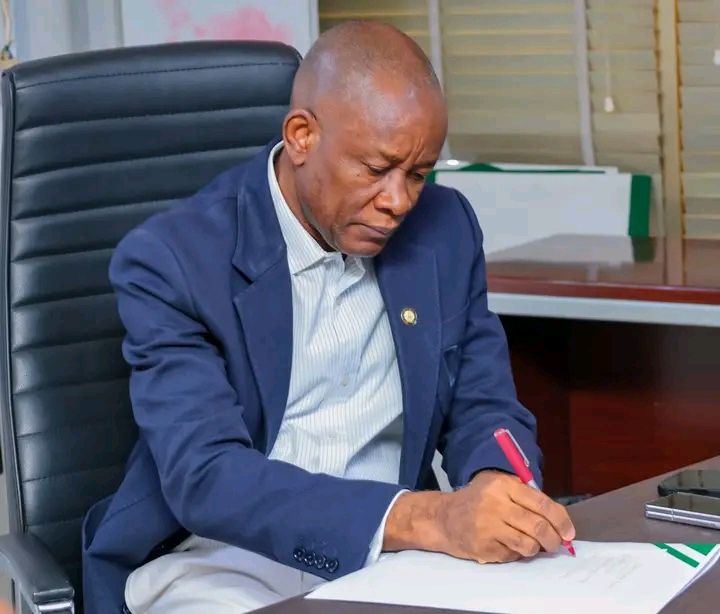
NIGERIA , ABUJA – Senator John Owan Enoh has clarified government’s position on revenue reforms and industrial protection, insisting that fiscal expansion must not undermine jobs or long-term manufacturing stability.
Truth Live News sighted the minister’s position in detailed statements shared via his verified social media handle.
Revenue Drive Must Not Undermine Jobs
Senator Enoh the Honourable Minister of State for Industry acknowledged that industry operators had engaged extensively with the Tariff Review Board and other relevant institutions before approaching his office.
He recognised those consultations as evidence that stakeholders understand the complexity of Nigeria’s fiscal reform environment.
However, he stated clearly that government must strengthen national revenue to meet expanding economic obligations.
“Government must strengthen national revenue,” he affirmed, stressing the urgency of sustainable public financing.
Despite that urgency, he warned that revenue mobilisation cannot come at the expense of employment and industrial survival.
“At the same time, it must protect jobs, encourage investment, and sustain industrial growth,” he added.
The minister rejected suggestions that revenue growth and industrial stability are opposing objectives.
“These objectives are not mutually exclusive, but they require careful calibration,” he declared.
His remarks signal a balancing strategy aimed at aligning fiscal discipline with economic productivity.
Policy analysts interpret this position as a call for measured tax reforms rather than abrupt fiscal tightening.
Call for Predictable and Transparent Regulation
Enoh stressed that fiscal measures must remain balanced and predictable to support long-term corporate planning.
“In my view, fiscal measures must be balanced, predictable, and supportive of long term planning,” he stated.
He argued that sudden or inconsistent tax frameworks discourage investment and distort industrial forecasts.
Manufacturers, he noted, depend on policy clarity to make capital-intensive production decisions.
The minister also addressed regulatory interventions, particularly traceability and compliance systems.
“Regulatory interventions, including traceability frameworks, should achieve their objectives without imposing avoidable operational burdens,” he explained.
He emphasised that compliant manufacturers should not face excessive administrative strain from new compliance measures.
According to him, regulatory efficiency strengthens confidence in government oversight mechanisms.
“Regulatory systems must be efficient, transparent, and aligned with national economic priorities,” he insisted.
Enoh’s position reinforces a governance approach that prioritises clarity, efficiency, and accountability.
Observers believe this framework could influence ongoing discussions around excise reforms and industrial taxation.
Nigeria Must End Raw Material Export Dependence
Shifting focus to Nigeria’s export structure, Enoh criticized the longstanding pattern of exporting raw commodities.
“Nigeria cannot continue to export raw materials while importing value,” he declared firmly.
He pointed to Nigeria’s strong standing in global shea production as an example of untapped industrial opportunity.
- Igbinedion School Expels Students, Police Invite Parents Over Viral Bullying Incident
- Igbinedion Education Centre Issues Statement Over Trending Students Assault Video
- Edo State Ministry Of Women Affairs Honours UBTH CMD Prof. Ize-Iyamu, Lists Contributions
- Doctor Arraigned Over IVF Scandal, Sale Of Couple’s Embryos
- Experts Raise Alarm Over Rising Advanced HIV Cases in Nigerian Children
“With our standing in global shea production, local processing and value addition must take priority,” he said.
The minister argued that exporting unprocessed commodities weakens domestic industrial capacity and limits job creation.
He maintained that value addition within Nigeria would expand employment and strengthen foreign exchange earnings.
Economic diversification, he suggested, depends on converting raw output into finished export-ready products.
Export Restriction Requires Data-Driven Consolidation
Enoh defended the Federal Government’s restriction on raw shea nut exports as a deliberate industrial strategy.
“Industrial transformation demands deliberate decisions,” he stated, underscoring policy intentionality.
He reminded stakeholders that the restriction has already taken effect and now requires consolidation.
“The restriction has been introduced. Our task now is to consolidate gains,” he affirmed.
According to him, government will rely strictly on verifiable data to evaluate policy impact.
He stressed that national economic interest must guide subsequent adjustments or refinements.
Protection of domestic industry, he argued, remains a legitimate development strategy under global practice.
“Protection of domestic industry is a legitimate development strategy,” he reiterated.
He described feedstock security as foundational to sustaining investments in local processing infrastructure.
Without guaranteed raw material supply, he warned, processing facilities risk underutilisation and financial instability.
Nigeria, he concluded, must transition from exporting commodities to exporting finished value-added goods competitively.
“ Nigeria must move from exporting commodities to exporting value added products,” he said.
Enoh’s combined fiscal and export policy positions reveal a consistent industrial philosophy.
He advocates balanced taxation, regulatory efficiency, domestic protection, and deliberate value chain development.
As fiscal reforms and export policies evolve, his message remains clear: revenue growth must reinforce, not weaken, Nigeria’s industrial transformation.
Most Viewed Posts
- Supporting Siminalayi Fubara: Why Rivers People Deserve Continuity Of Purpose In 2027 – Dr William Omuna
- President Tinubu’s Achievements That Strengthen Case For Second Term – Amuna
- William Omuna Declares Bid For Rivers East Senate, Says It Deserves Senator Who Shows Up
- Budget Without Representation: Outrage as Senator Natasha Alleges Institutional Marginalisation – By Darlington Okpebholo Ray
- Praying for Survival: Inside Nigeria’s Unchecked Violence Against Christians — By Darlington Okpebholo Ray