

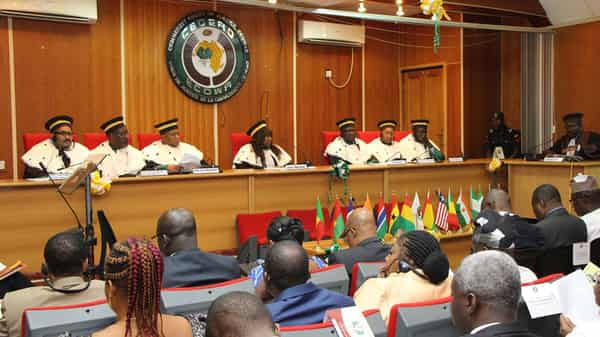
The ECOWAS Community Court of Justice has ruled that it has the authority to hear a human rights case brought against Nigeria by activist Musa Ali Maishanu, rejecting an objection by the federal government.
In a decision delivered virtually in Abuja under Application No. ECW/CCJ/APP/11/25 (Ruling No. ECW/CCJ/RUL/01/26), the regional court dismissed Nigeria’s preliminary challenge to its jurisdiction and declared the application admissible, clearing the way for a full hearing.
Mr Maishanu, a resident of Adamawa State and regional coordinator of the Global Pan-Africanism Network (G-PAN) in Nigeria’s North-East, alleges that he was unlawfully arrested by operatives of the Department of State Services in Gombe State on 18 October 2022.
He claims he was detained, subjected to degrading treatment and later prosecuted on charges of criminal intimidation and conspiracy. According to court filings, he was arraigned three days after his arrest, granted bail on 26 October 2022 and eventually secured relief in July 2024 when the High Court in Gombe lifted restrictions imposed on him.
Mr Maishanu argues that his arrest, detention and prosecution were malicious and violated his rights to personal liberty, dignity and freedom of movement. He is seeking ₦5bn in general damages, ₦100m in special damages for alleged malicious prosecution, and a public apology from the Nigerian government.
The federal government, represented by its counsel, Maimuna Lami Shiru, denied the allegations and maintained that the arrest and prosecution were lawful under Nigerian law.
It argued that the case was criminal in nature and fell within the exclusive jurisdiction of domestic courts. The government also contended that the regional court lacked authority because the claims did not amount to enforceable human rights violations.
In its ruling, a three-judge panel held that the mere allegation of human rights violations within a member state is sufficient to establish the court’s jurisdiction under its protocol. The judges said the validity of the claims would be examined at the substantive stage of the proceedings.
The court also noted that there was no evidence the matter had been decided by another international tribunal, satisfying requirements for admissibility.
The case will now proceed to a full hearing, with the issue of costs to be determined in the final judgment.