
Nigeria has entered into a far-reaching and contentious migration agreement with the United Kingdom, paving the way for the deportation of thousands of failed asylum seekers, visa overstayers, and convicted offenders back to the West African nation.
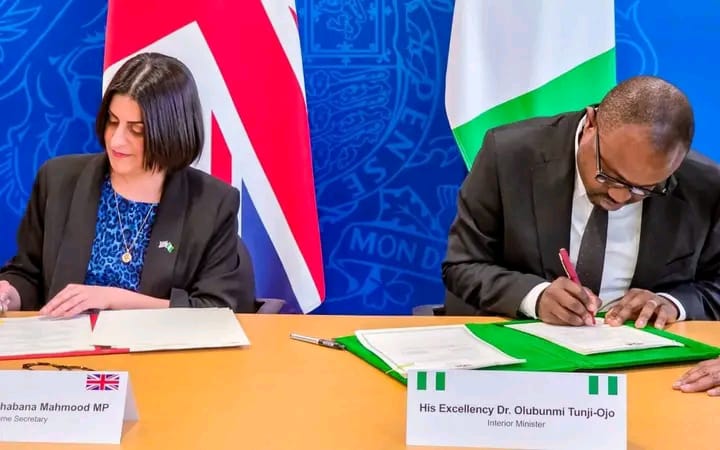
The deal was formally signed by Nigeria’s Minister of Interior, Olubunmi Tunji-Ojo, and the UK Home Secretary, Shabana Mahmood, during President Bola Ahmed Tinubu’s state visit to the United Kingdom, according to an announcement by the UK Home Office on Thursday.
Under the agreement, Britain will now have expanded authority to return individuals who have exhausted their asylum appeals, violated visa conditions, or committed crimes. In a significant policy shift, Nigeria has agreed—for the first time—to accept UK-issued identification letters as valid documentation for deportees who lack passports.
This marks a departure from previous practice, where emergency travel certificates were required to facilitate repatriation. The UK government described Nigeria’s acceptance of these alternative documents as a major breakthrough in removing bureaucratic bottlenecks that had long delayed deportations.
Although the exact commencement date and duration of the agreement remain unclear, officials suggest it will fast-track removals. Reports indicate that at least 961 Nigerian failed asylum seekers and over 1,100 Nigerian foreign national offenders currently awaiting deportation in the UK could be affected.
The new deal comes in the wake of the UK’s controversial 2022 migration agreement with Rwanda, which involved plans to relocate asylum seekers offshore at a cost of £370 million. That arrangement was later scrapped after British Prime Minister Keir Starmer declared it “dead,” citing legal and ethical concerns.
Unlike the Rwanda model, the Nigeria agreement focuses primarily on returning individuals to their country of origin, though it remains unclear whether third-country nationals could also be included.
Defending the move, Tunji-Ojo emphasized Nigeria’s commitment to international responsibility and lawful migration processes.
“We are totally committed to being a responsible country in fulfilling our core obligations,” he stated. “For us to sustain that relationship, we must be as open and as fair as possible.”
UK Tightens Immigration Enforcement
UK Minister for Border Security and Asylum, Alex Norris, described Nigeria as a crucial ally in curbing illegal migration, noting its status as the UK’s largest African visa market.
“Anyone who abuses our systems, breaks our laws or tries to cheat their way into Britain will be stopped and removed,” Norris said.
Beyond deportations, the agreement also introduces a joint security framework targeting organized immigration fraud. Authorities from both countries will collaborate on intelligence-sharing and coordinated operations to dismantle criminal networks exploiting visa systems through fake job offers, sham marriages, and forged documents.
Additionally, a new “fusion cell” initiative will bring together government agencies, financial institutions, tech firms, and telecommunications companies to combat online scams, including romance fraud, investment schemes, and cryptocurrency-related crimes.
Nigeria is also expected to tighten its domestic laws to impose stricter penalties on immigration-related offenses, signaling a broader effort to align with international enforcement standards.
Despite official optimism, the agreement raises critical questions about its implementation, potential financial arrangements, and the broader socio-economic implications for Nigeria.