

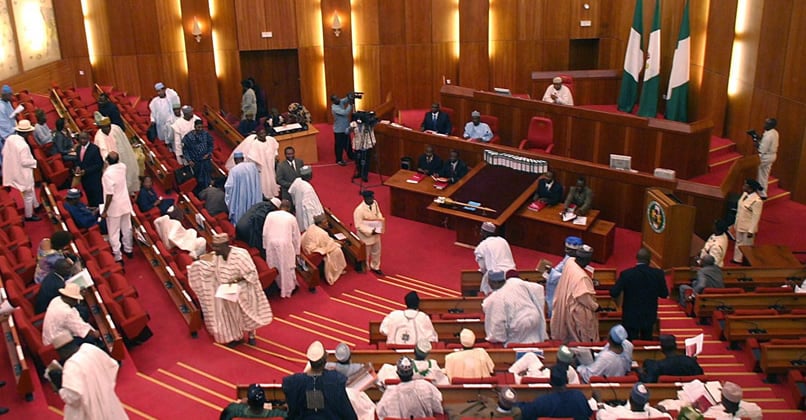
Commotion has greeted the house of senate as plan to amend the Electoral Act met a brick wall
The brick wall was met at Clauses 51–60, the section of the Electoral Act Amendment Bill that deals with the contentious issue of electronic transmission of election results.
The Senate had repealed the entire Electoral Act 2022 and commenced a clause-by-clause reenactment in Committee of the Whole as part of efforts to amend the law ahead of the 2027 general elections.
However, deliberations slowed dramatically when lawmakers reached the transmission provisions.
Senators were seen engaging in intense group consultations across the chamber, while some gathered around the podium of the Senate President amid visible tension.
After nearly 20 minutes of informal discussions, Senate Leader Opeyemi Bamidele moved a motion for the chamber to enter a closed-door session, which was subsequently adopted at about 1:3pm.
Move to avoid open confrontation, it was learnt that the decision to proceed behind closed doors was aimed at resolving disagreements quietly and avoiding a repeat of the situation in the House of Representatives, where sharp divisions over the same transmission clause reportedly led to disorder before lawmakers retreated into a private session.
At the time of filing this report, both chambers of the National Assembly are in closed-door sessions over the Electoral Act Amendment Bill.
Earlier dramatic repeal
Earlier in the day, the Senate, sitting as Committee of the Whole, repealed Clauses 1–156 of the 2022 Electoral Act via voice vote and began fresh consideration for reenactment.
The process followed a substantive motion for rescission and recommittal sponsored by Senator Bamidele, who invoked Order 52(6) of the Senate Standing Rules to justify reopening the Bill.
Bamidele had pointed out that although the Electoral Act (Repeal and Re-enactment) Bill, 2026, was passed during an emergency sitting last week, fresh developments, particularly concerns raised by the Independent National Electoral Commission (INEC) over the 2027 election timetable, necessitated urgent legislative amendments.
INEC had fixed the Presidential and National Assembly elections for February 2027, but later indicated that the date may conflict with the Ramadan fasting period.
Additionally, the 360-day notice requirement in the amended law reportedly constrained the Commission’s ability to adjust its timetable without further legislative action.
Transmission clause at the centre
Before proceedings were suspended, Chairman of the Senate Committee on Electoral Matters, Simon Lalong, had presented the Harmonisation Committee’s recommendation supporting real-time electronic transmission of results to INEC’s Result Viewing Portal (IReV), with a manual backup mechanism for areas with poor network coverage.
It is this framework, particularly the balance between mandatory electronic transmission and contingency manual processes, that is understood to be at the heart of the current challenge.