


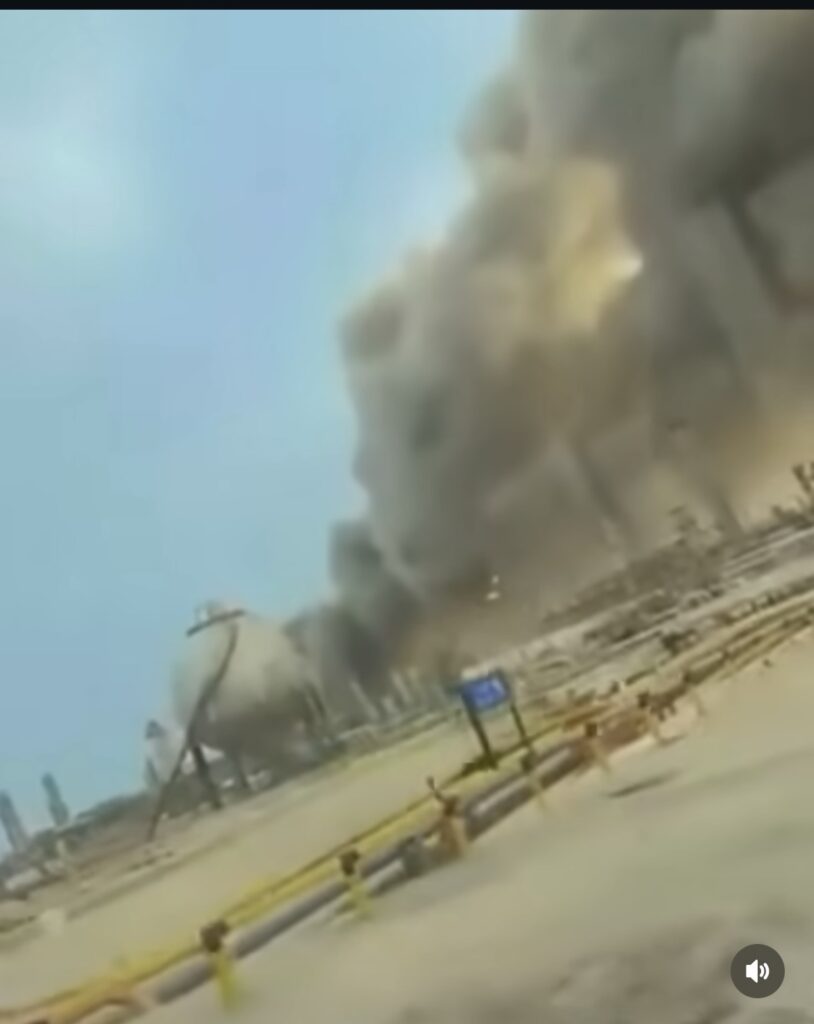
Iran has taken the war directly to Saudi Arabia’s most critical energy infrastructure.
In a significant escalation of the ongoing Middle East conflict, an Iranian drone struck Saudi Aramco’s Ras Tanura refinery in the Eastern Province of Saudi Arabia on Monday March 2, 2026 the first time Iran has directly targeted Gulf energy infrastructure since hostilities began on Saturday.
Saudi authorities confirmed the facility was hit by an Iranian-made Shahed-136 drone, causing a fire that officials described as small, isolated and quickly brought under control. There were no reported casualties and preliminary assessments indicated no major damage to critical production systems.
Saudi Aramco temporarily shut down operations at the refinery as a precautionary measure while assessing damage, with Saudi state television citing an official source confirming the decision. The Saudi defence ministry added that incoming aircraft had been intercepted before reaching the facility.
The Ras Tanura complex which is situated on Saudi Arabia’s eastern coast along the Persian Gulf, houses one of the Middle East’s largest refineries with a processing capacity of 550,000 barrels per day and serves as a critical export terminal for Saudi crude. The refinery and export terminal process and ship crude sourced from some of the kingdom’s largest fields including Ghawar, the world’s largest conventional oilfield.
Oil Prices Surge to $80 as Iran Strikes Spread Across the Gulf — Nigeria Faces Fuel Price Threat
Energy markets are reeling.
Brent crude jumped to $80 per barrel on Monday 2nd March, rising approximately 8 to 9 percent in a single trading session following Iran’s strike on Saudi Arabia’s Ras Tanura refinery. Crude oil in London climbed nearly 10 percent from the moment US and Israeli strikes on Iran began over the weekend, one of the sharpest energy price movements the market has seen in years.
The scale of Iran’s retaliation across the Gulf has made the situation significantly worse. Iranian strikes have now landed in Bahrain, Iraq, Jordan, Kuwait, Oman, Qatar, Saudi Arabia and the UAE, with attacks on Abu Dhabi, Dubai, Doha, Manama and Oman’s commercial port of Duqm bringing major shipping activity across the region to a near standstill.
The world’s most critical oil corridor is now under direct threat. The Strait of Hormuz through which roughly 20 percent of the world’s daily oil supply passes, remains deeply uncertain, with several major shipowners already suspending transit through the waterway as a precautionary measure.
Analysts warn that any sustained disruption to exports from Saudi Arabia or neighbouring producers could drive prices even higher, adding fresh inflationary pressure to an already strained global economy.
Saudi Arabia has condemned the attacks in the strongest terms. “The Kingdom of Saudi Arabia expresses its rejection and condemnation in the strongest terms of the blatant and cowardly Iranian attacks,” the Foreign Ministry said in a statement, while stressing that Riyadh had not permitted its territory or airspace to be used in any operations against Iran.
The attack also puts Crown Prince Mohammed bin Salman in an increasingly difficult position. The Saudi leader has spent years carefully maintaining neutrality in regional disputes, largely to protect his ambitious economic diversification agenda. A direct and sustained threat to the kingdom’s oil assets may prove impossible to ignore and could force Riyadh to abandon that neutrality, a development that would add yet another dangerous dimension to an already explosive situation.
President Trump has confirmed the bombing campaign against Iran will continue, possibly for weeks, offering no indication of where or when it ends.
For Nigeria the consequences are not distant or theoretical. Nigeria imports refined petroleum products and prices them in dollars. A sustained oil price surge combined with dollar strengthening flows directly into fuel costs at home. At a time when Nigerians are already navigating a weakened naira and rising cost of living, an externally driven fuel price shock is the last thing the economy can absorb and right now, all the signals point in exactly that direction.