

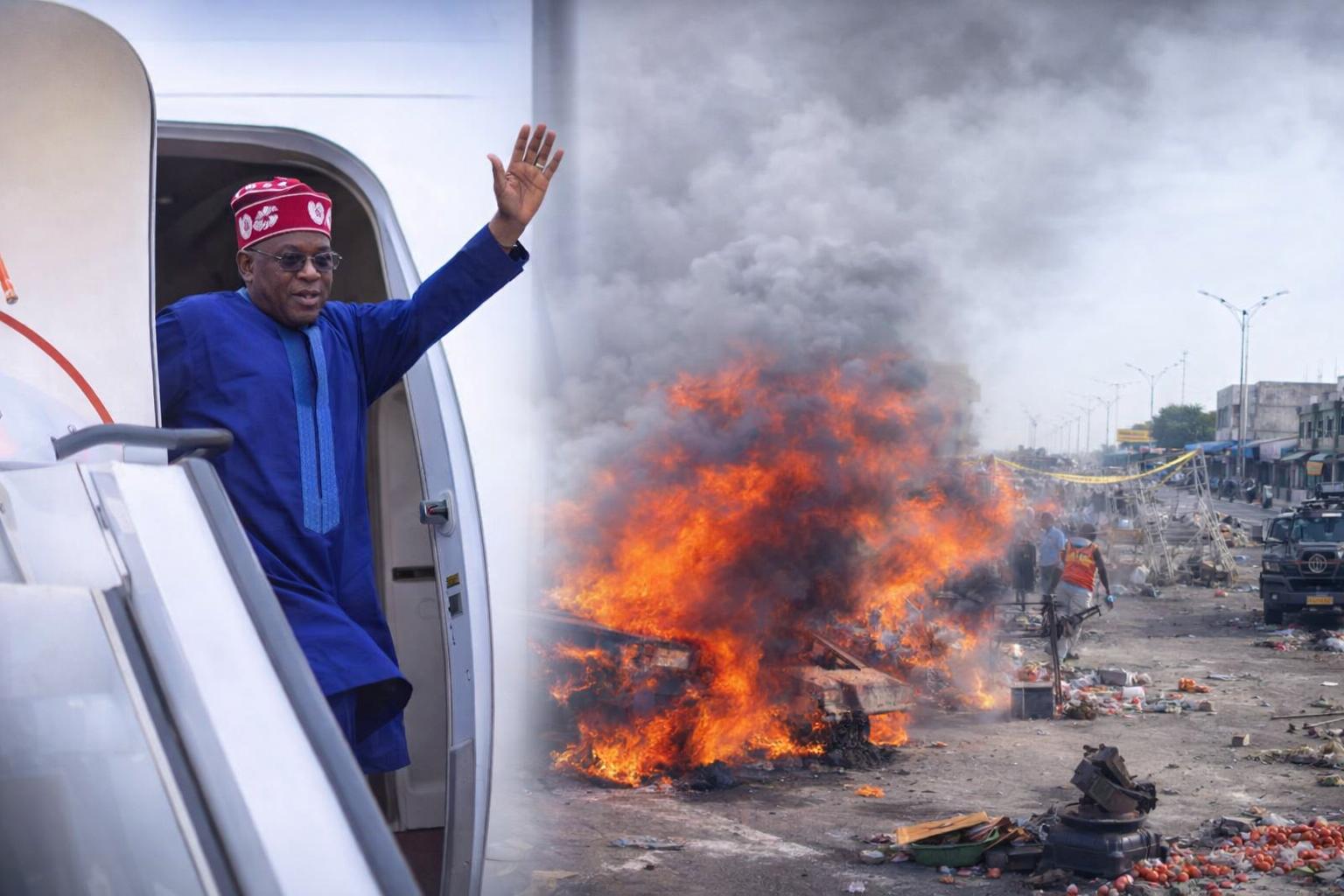
In what can only be described as a painful contradiction of leadership and reality, Nigeria once again stands exposed before the world, not as a nation in control of its destiny, but as a country struggling under the weight of insecurity, detachment, and failed governance.
While the President of Nigeria, accompanied by a bloated entourage of political loyalists and government officials, dines in splendour at a state banquet in Windsor Castle hosted by King Charles III, the streets of Maiduguri and other parts of the northeastern region are drenched in blood. The distance between London and Borno is not just geographical, it is symbolic of a leadership class far removed from the suffering of its people.
Only yesterday, tragedy struck with devastating force. Multiple coordinated bombings, reportedly carried out by the dreaded Boko Haram insurgents, tore through civilian populations, leaving behind charred bodies, shattered families, and communities plunged into mourning. Men, women, and children, innocent Nigerians whose only crime was existing in a region long abandoned to terror, were blown apart in cold blood. 23 people have been confirmed dead while 108 are critically injured.
And yet, at that same moment, glasses were raised in celebration thousands of miles away.
This is the irony of a conquered country.
A nation where leaders celebrate diplomacy abroad while their citizens bury loved ones at home. A country where the urgency of human life is overshadowed by the optics of international recognition and ceremonial prestige. A government that appears more concerned with handshakes in foreign palaces than with the cries of its own people echoing from bombed villages.
The primary responsibility of any government is clear: the protection of lives and property. It is the most basic social contract between the state and its citizens. Yet, in Nigeria today, that contract lies in ruins. The persistent killings, kidnappings, and acts of terror across the country have become so routine that they barely provoke the level of outrage they deserve.
What does it say about a nation when mass death becomes background noise?
What does it say about leadership when tragedy is met with silence, or at best, recycled statements of condemnation that have long lost meaning?
The people of northeastern Nigeria have endured years of insurgency, displacement, and unimaginable hardship. Entire communities have been wiped out, livelihoods destroyed, and a generation raised under the shadow of fear. And still, the response remains inadequate, inconsistent, and painfully slow.
Meanwhile, governance continues in two parallel realities. One of luxury, diplomacy, and ceremonial appearances. The other of blood, tears, and survival.
This widening disconnect raises a troubling question: has Nigeria become a country where the ruling elite and the ordinary citizens no longer share the same reality?
Because a nation is not truly sovereign when its people live at the mercy of terrorists. A country is not truly governed when its citizens must fend for themselves in the face of violence. And leadership is not truly leadership when it fails to act decisively in moments that demand courage, urgency, and accountability.
History will not judge this era by the number of foreign visits or state banquets attended. It will judge it by the lives lost, the communities destroyed, and the opportunities squandered to protect a nation in distress.
As the music plays in Windsor and the toasts continue under glittering chandeliers, one can only hope that somewhere, in the quiet of that grandeur, there is a moment of reflection. A moment to remember that far away from the banquet halls, a nation is bleeding.
And that the true measure of leadership is not how well one is received abroad, but how fiercely one defends the lives at home.
Deacon Ambassador Darlington Okpebholo Ray, a political analyst, Journalist, Media consultant, social and Human Rights activist writes from London, United Kingdom.

One Response
I left Nigeria in 1986 and took refuge in United States of America waiting for the nation or it people to proved me wrong that I shoud have stayed.
Still waiting?
Douglas Oboh
d.oboh@comcast.net