
Residents of Yelwata community in Benue State have called for urgent government protection and humanitarian support following last year’s deadly attack, as Germany reaffirmed its commitment to supporting Nigeria in tackling insecurity and promoting peaceful coexistence.
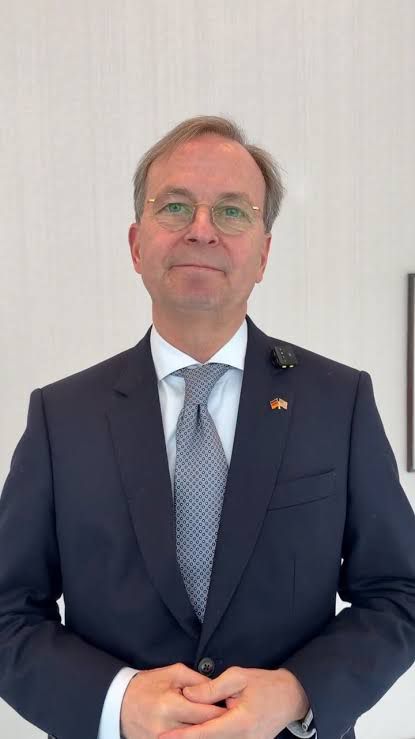
Germany’s Federal Government Commissioner for Freedom of Religion or Belief, Thomas Rachel, made this known during a press briefing in Abuja on Tuesday, April 28, 2026, after a fact-finding visit to affected communities, including internally displaced persons (IDP) camps.
Rachel described his visit to Yelwata as deeply emotional, noting that survivors of the June 2025 massacre—where over 200 Christians were killed—are still gripped by fear over their safety and future.
“I am still moved by my visit to Yelwata, the village where a massacre took place in June 2025. More than 200 Christians were killed there.
“The people I spoke with asked for safety. They asked what the government can do. They asked for support for their livelihoods, and they want a chance to return from IDP camps to their ancestral homes,” he said.
The attack occurred in the early hours of June 13, 2025, when more than 100 armed assailants invaded the farming community, located about 7km north of Makurdi in Guma Local Government Area. Over 200 villagers were killed, about 3,000 displaced, and several homes razed.
Yelwata, which also hosted displaced persons from earlier attacks in neighbouring communities, was left devastated, with many residents sustaining injuries.
The incident forms part of a broader wave of violence affecting parts of Nigeria, particularly in the Middle Belt and North-East regions.
Rachel noted that insecurity remains a major concern nationwide, stressing that both Christians and Muslims are victims of extremist violence.
“You see that Christians and Muslims have a common enemy—terrorists. Let me express my full solidarity with Nigeria,” he said.
During his visit, the German official met with victims, religious leaders, government representatives, and community members, observing widespread uncertainty among affected populations.
“I spoke with Muslims, Christians, and humanist representatives. I visited the IDP camp at the International Market in Makurdi and spoke with victims. You can feel that they are unsure about their future, and that is deeply troubling,” he added.
Rachel also raised concerns over alleged human rights violations linked to the application of blasphemy laws in some northern states, warning that such practices could undermine freedom of religion and belief.
He highlighted the complexity of Nigeria’s security challenges, pointing to terrorism in the North and farmer-herder conflicts in the Middle Belt as key drivers of violence.
“We have conflicts between farmers and herders in the Middle Belt, while in the North, people are being killed by Boko Haram and ISWAP. It is a serious terrorist problem,” he said.
The commissioner emphasised the need for dialogue, tolerance, and mutual respect among religious groups as critical steps toward resolving the crisis.
“Nigeria is one of our key partners in Africa, and both Nigeria and Germany share democratic values. Germany remains committed to promoting freedom of religion and belief,” he said.
He reiterated that Germany would continue to support Nigeria through political, economic, and peace-building initiatives, including mediation efforts in partnership with international organisations.
On military cooperation, Rachel clarified that Germany would not deploy troops but would continue to provide advisory and training support to Nigeria’s military.
“We have personnel from our Bundeswehr who support and train the Nigerian military. However, we will not engage in direct military operations. Nigeria is a strong country,” he said.
Reaffirming Germany’s long-standing partnership with Nigeria, he stressed that unity across religious and ethnic lines remains essential for achieving lasting peace.
“As long as people live in fear, it remains a challenge for the entire country and the government,” he added.