

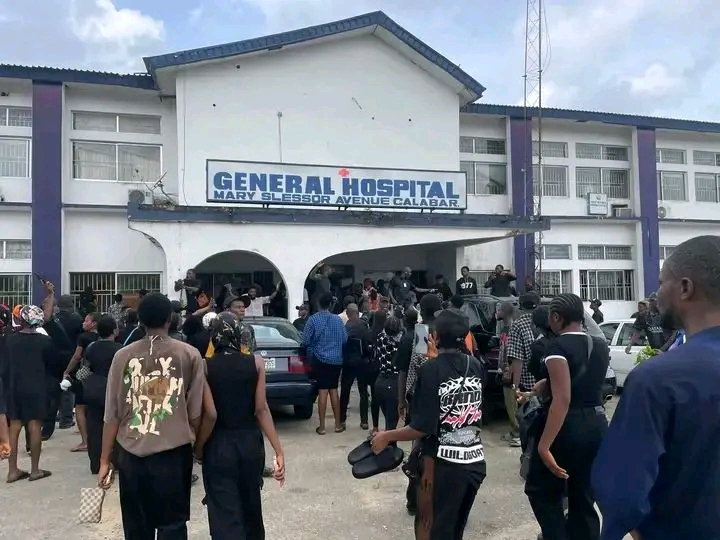
CALABAR, CROSS RIVER – Two separate official statements from the Cross River State Government and the Police Command have presented a strikingly unified account of the UNICROSS student protest, firmly denying that security operatives opened fire, while shifting attention to protest violence and public order concerns.
The alignment in both reports comes amid growing public scrutiny following the deaths of three University of Cross River State (UNICROSS) students in a fatal road accident along the Itu–Odukpani Road, a tragedy that triggered widespread protests across Calabar.
In a press statement signed by Fred Abua, Press Secretary to the Deputy Governor, the state government confirmed that the protest escalated after initially peaceful demonstrations.
The statement acknowledged that students blocked major routes, including Millennium Park, before tensions degenerated into disorder.
Similarly, a separate press release issued by the Cross River State Police Command, signed by Police Public Relations Officer ASP Eitokpah Sunday Akata, described an almost identical sequence, peaceful protest turning violent, with incidents of vandalism reported at the General Hospital and attempts to breach Government House security.
At the center of both reports is a strongly emphasized and repeated claim: no protester was shot.
The government statement noted that police used tear gas to disperse the crowd after the situation became rowdy, stressing that “no one was shot.”
In near-identical language, the police command stated “no protester was shot, no protester was targeted with firearms, and at no time were live rounds discharged.”
This consistency in messaging underscores a coordinated official position aimed at countering viral social media content alleging police shootings during the protest.
Both authorities also highlighted the use of non-lethal crowd control measures, framing police actions as restrained and necessary to restore order.
The police specifically referenced the use of smoke canisters, while the government described tear gas deployment, two accounts that reinforce each other’s core narrative.
Beyond the denial of gunfire, the reports share additional common ground: Both confirm the protest was triggered by the death of three students in a road accident.
Both describe a transition from peaceful protest to violence, citing vandalism of public property.
Both emphasize government engagement with student leaders, including meetings with the Deputy Governor.
Both warn against misinformation and exaggerated narratives, urging the public to disregard unverified social media claims.
While these shared elements present a coherent official version of events, they also raise critical questions about the absence of independent verification.
Neither report provides medical records, forensic evidence, or third-party accounts to substantiate the claim that no live ammunition was used.
Attention has also turned to the healthcare system’s response in the immediate aftermath of the accident.
The government acknowledged that the General Hospital was overwhelmed, leading to the diversion of victims to the University of Calabar Teaching Hospital (UCTH).
Officials insisted this was due to capacity strain rather than systemic inadequacy, but the admission has intensified concerns about emergency preparedness.
The Deputy Governor’s office highlighted swift intervention efforts, including direct engagement with student leaders and logistical support for evacuating injured victims.
The police, on their part, credited early intelligence and rapid deployment for preventing a complete breakdown of law and order.
However, both reports are notably silent on key issues that remain central to public concern.
There is no detailed account of injuries sustained during the protest, no confirmation of arrests, and no inclusion of testimonies from students, eyewitnesses, or medical personnel.
The Itu–Odukpani Road, where the fatal accident occurred, has long been associated with safety concerns, yet neither report provides insight into the immediate cause of the crash or any timeline for infrastructural intervention.
For many observers, the convergence of both statements strengthens the credibility of the “no shooting” claim, but does little to address broader accountability gaps.
As calm gradually returns following a closed-door meeting between student representatives and the Deputy Governor, the focus is shifting from immediate crisis management to deeper structural questions, road safety, hospital capacity, and transparency in law enforcement conduct.
The tragedy that claimed three young lives has now evolved into a broader test of public trust.
And while the government and police appear united in their narrative, the demand for independent verification and fuller disclosure continues to grow.
Most Viewed Posts
- Supporting Siminalayi Fubara: Why Rivers People Deserve Continuity Of Purpose In 2027 – Dr William Omuna
- President Tinubu’s Achievements That Strengthen Case For Second Term – Amuna
- William Omuna Declares Bid For Rivers East Senate, Says It Deserves Senator Who Shows Up
- Budget Without Representation: Outrage as Senator Natasha Alleges Institutional Marginalisation – By Darlington Okpebholo Ray
- Praying for Survival: Inside Nigeria’s Unchecked Violence Against Christians — By Darlington Okpebholo Ray