
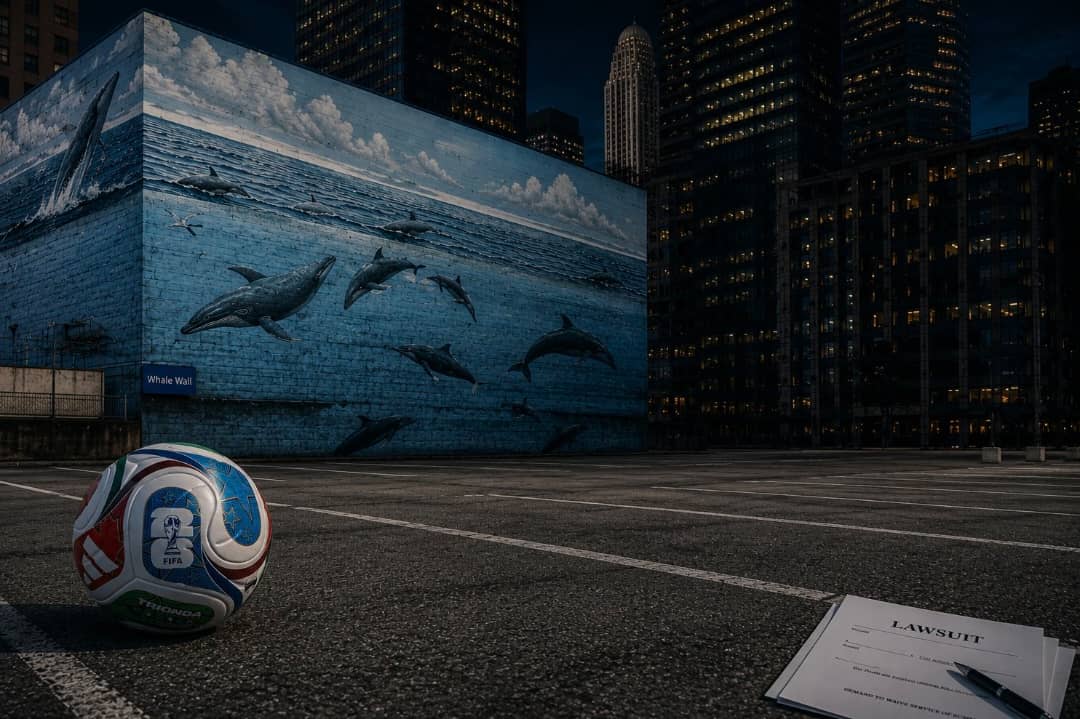
Marine artist Wyland has filed a $25 million federal lawsuit against FIFA and others, alleging that World Cup organizers illegally painted over his giant mural of life-sized swimming whales on a building in downtown Dallas to promote the city’s upcoming World Cup matches.
The mural, known as “Whaling Wall 82” or “Ocean Life,” was created by Wyland in 1999 as part of a 100-piece series designed to raise awareness about ocean pollution, and covered roughly 17,000 square feet across two of the building’s walls.
Wyland filed suit in U.S. District Court in Dallas, arguing that the mural was painted over without his consent or even notification, in violation of the Visual Artists Rights Act, a 1990 federal law that protects publicly displayed works from destruction.
The building’s owner, Slate Asset Management, said it was approached by Downtown Dallas Inc. and the North Texas FIFA World Cup organizing committee in March 2026 with a request to donate the wall space for a new public art installation by a local Dallas artist, and that it was told by local partners that Wyland had been notified.
The area’s World Cup organizing committee, for its part, said the new artwork would “capture this current historical moment and reflects the energy, unity, and global spirit surrounding the World Cup 2026,” and noted that a portion of Wyland’s mural would be preserved. FIFA, however, distanced itself entirely, stating:
“FIFA has no involvement in this whatsoever and refers all inquiries on this matter to the host city committee.”
Residents reacted with anger and confusion as the mural disappeared, prompting online petitions and community debate over whether the city should have intervened.
The lawsuit noted that “Dallas and Wyland deserved better,” describing the destruction of the artwork as a personal tragedy to both the artist and the local community.
Wyland said the episode should have been an opportunity to demonstrate that “global sports, public art, and environmental stewardship can stand together,” the case is now set to test the boundaries of federal protections for public art in the face of major commercial sporting events.