

Lucky Obukohwo Reporting
The Nigeria Football Federation (NFF) has escalated its dispute over Edo Queens’ WAFU-B final victory to the Confederation of African Football (CAF), formally seeking the reversal of a decision that nullified the Nigerian champions’ shoot-out triumph over Ghana’s Ampem Darkoa Ladies.
In a petition submitted on Tuesday, the NFF asked the CAF Appeals Committee to overturn the ruling directing that the final resume from extra time.
The federation argued that Edo Queens should not be penalised for a procedural error attributed to the match officials.
The controversy stems from the September 5 final in Ouagadougou, Burkina Faso, which ended 2-2 after 90 minutes.
Instead of playing the stipulated two 15-minute periods of extra time, the officials proceeded directly to a penalty shoot-out.
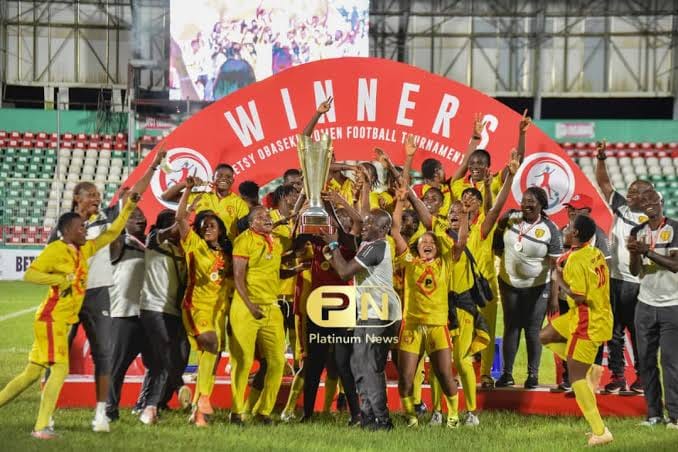
Edo Queens won the shoot-out 4-1 to claim the WAFU-B title and secure the zone’s ticket to the CAF Women’s Champions League.
The subsequent decision to set aside the result has now triggered the NFF’s appeal to CAF, with the federation insisting that the Nigerian champions should not be penalised for an error they did not commit.
Ampem Darkoa subsequently protested the procedure, contending that the competition regulations required extra time before penalties.
CAF upheld the protest, finding that the decision to proceed directly to penalties was inconsistent with Article 72.4 of the competition regulations.
However, in its petition, the NFF contended that the ruling failed to properly establish responsibility for the procedural error, stressing that neither Edo Queens nor Ampem Darkoa determined the duration or procedure of the match.
“Edo Queens neither elected nor requested that extra time be dispensed with,” the federation stated, maintaining that the Nigerian players merely complied with the instructions of the appointed match officials.
The NFF further argued that there was no finding that Edo Queens committed misconduct, manipulated the procedure, acted in bad faith or deliberately sought to avoid extra time.
It therefore questioned the legal basis for imposing the consequences of the officials’ error on the Nigerian champions.
“The fact that Edo Queens ultimately won the shoot-out cannot retrospectively convert its compliance with the referee’s instruction into responsibility for the regulatory breach,” the federation argued.
At the heart of the petition is also the question of remedy. The NFF does not dispute that the regulations required extra time; rather, it is asking CAF to establish whether its regulations specifically empower the body to invalidate a completed penalty shoot-out and order a final to resume from extra time where neither participating team caused the irregularity.
The federation urged the Appeals Committee to consider the proportionality and regulatory foundation of the remedy, arguing that a finding that a procedural irregularity occurred should not automatically determine the appropriate consequence without establishing the responsibility of the parties affected.
The NFF consequently requested that CAF reverse the decision, restore Edo Queens’ WAFU-B championship and preserve the Nigerian club’s qualification for the CAF Women’s Champions League, insisting that the integrity of African club football also requires accountability to be placed on the actors responsible for administering the rules.