
On Wednesday night, the football world will once again come to a standstill as England and Argentina renew one of the greatest rivalries the beautiful game has ever known.
This is far more than a World Cup semifinal. It is another chapter in a football story that has captivated generations for more than six decades. It is a rivalry built on unforgettable victories, heartbreaking defeats, controversial decisions, moments of individual brilliance and stories of redemption that have become part of football folklore.
History has already written its opening chapters. On Wednesday, another generation will write the next.
The rivalry first ignited on football’s biggest stage at the 1962 FIFA World Cup in Chile. England defeated Argentina 3 1 in the group stage, planting the seeds of what would become one of international football’s fiercest contests.
Four years later, the rivalry took on a whole new meaning.
At the 1966 FIFA World Cup quarterfinal at Wembley, England defeated Argentina 1 nil thanks to a goal from Geoff Hurst. The match became infamous after Argentina captain Antonio Rattin was controversially sent off. While England celebrated another step towards lifting the Jules Rimet Trophy for the first and only time, Argentina believed they had been unfairly treated. The bitterness from that afternoon lingered for decades.
Then came Mexico in 1986.
No football match has ever produced two goals that so perfectly captured the genius and controversy of one player.
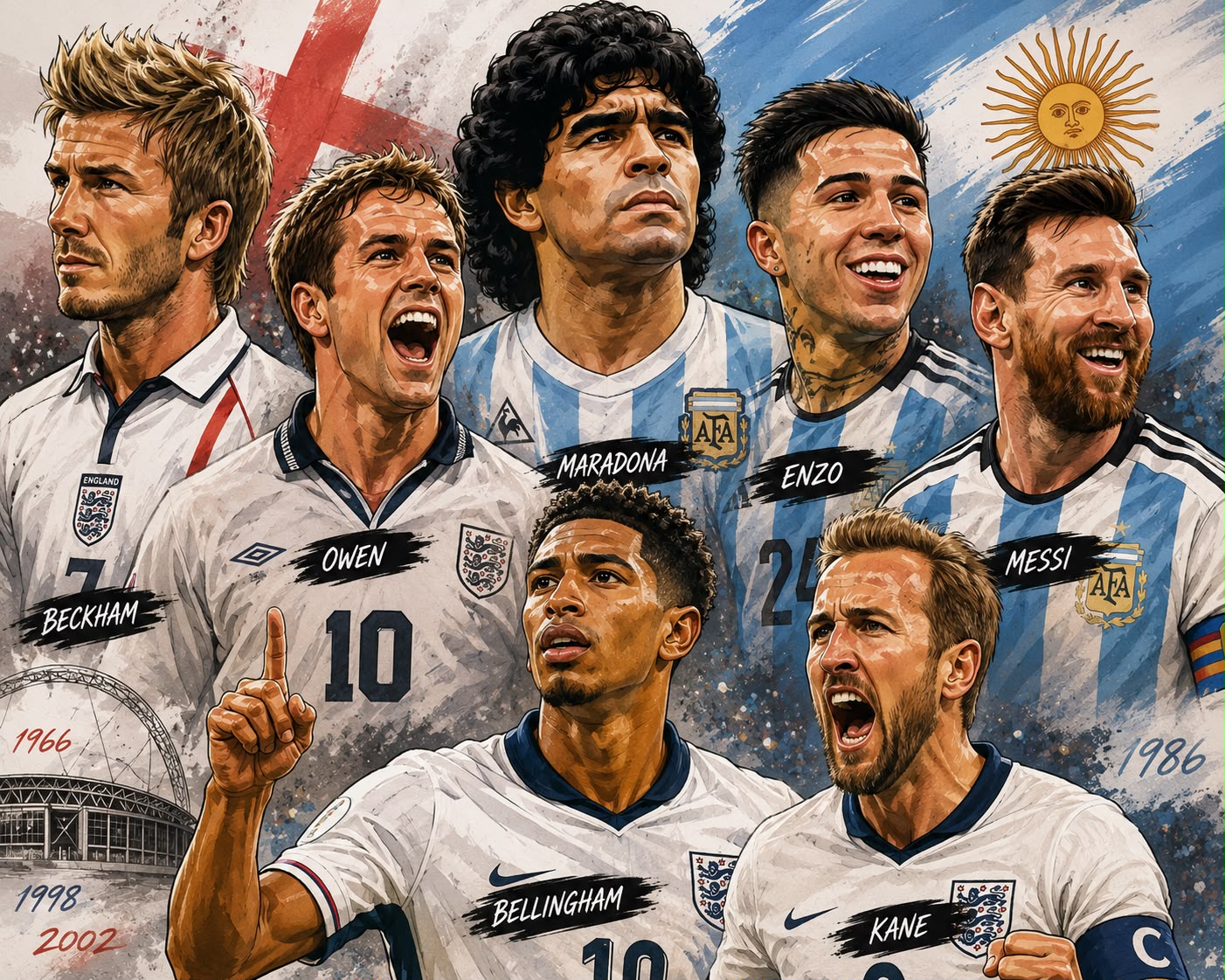
In the 51st minute, Diego Maradona punched the ball past Peter Shilton in what would forever become known as the Hand of God. The officials failed to spot the offence and the goal stood.
Only four minutes later, in the 55th minute, Maradona produced footballing perfection. Picking up the ball inside his own half, he danced past five England players before calmly rounding Shilton to score what FIFA would later recognise as the Goal of the Century.
Within four extraordinary minutes, Maradona became both football’s greatest villain and one of its greatest geniuses.
For England supporters, the wounds have never fully healed.
For Argentina, those moments became symbols of national pride.
Twelve years later, football offered another unforgettable chapter.
At the 1998 FIFA World Cup in France, England possessed one of the most exciting young squads in the world. A teenage Michael Owen announced himself to the footballing world in spectacular fashion. Just 18 years old, Owen collected the ball near the halfway line in the 16th minute, accelerated beyond a line of Argentine defenders and unleashed an unstoppable finish beyond Carlos Roa. It remains one of the greatest solo goals ever scored at a World Cup.
Yet that moment of brilliance was overshadowed after halftime.
In the 47th minute, 23 year old David Beckham reacted to a challenge from Diego Simeone and was shown a red card. Reduced to ten men, England fought courageously before eventually losing on penalties.
Back home, Beckham became England’s most criticised footballer. He carried the weight of an entire nation’s disappointment for four painful years.
Football, however, has a remarkable way of rewarding perseverance.
At the 2002 FIFA World Cup in Japan, Beckham returned to face Argentina once again. Now England captain and 27 years old, he carried not only the hopes of his country but also the burden of redemption.
In the 44th minute, Beckham calmly converted a penalty to give England a famous 1 nil victory.
The redemption was complete.
The man once blamed for England’s downfall had become the hero who restored national pride.
As Beckham’s era gradually gave way, another young star emerged.
Wayne Rooney exploded onto the international stage and became England’s new symbol of hope during the 2004 European Championship and the 2006 FIFA World Cup. Alongside Beckham, Steven Gerrard, Frank Lampard, John Terry, Rio Ferdinand and Ashley Cole, Rooney represented what many believed was England’s golden generation. Despite their immense talent, the ultimate prize always remained just beyond their reach.
Now, in 2026, another generation carries England’s dreams.
Jude Bellingham has become the heartbeat of the national team, combining extraordinary maturity with world class ability. Captain Harry Kane continues to lead from the front with goals and experience. Declan Rice provides authority and balance in midfield, while Bukayo Saka has thrilled supporters with his pace, creativity and fearless attacking play.
They now stand where Charlton once stood.
Where Hurst once stood.
Where Beckham, Owen and Rooney once stood.
Waiting for their opportunity to create history.
Argentina, meanwhile, continue to produce footballers capable of carrying the enormous expectations of a nation where football is woven into everyday life. Every generation has produced heroes determined to honour the legacy of Diego Maradona and, more recently, Lionel Messi.
That is why England against Argentina remains unlike any other football match.
It is not driven by geography.
It is not driven by politics alone.
It is driven by memory.
Memory of 1962.
Memory of Wembley in 1966.
Memory of the Hand of God and the Goal of the Century in 1986.
Memory of Michael Owen’s breathtaking run in 1998.
Memory of David Beckham’s tears in France and his redemption in Japan.
Memory of generations of supporters who have lived every kick, every tackle, every celebration and every heartbreak.
Now another generation has the opportunity to add its own chapter.
For younger fans, Wednesday offers the chance to witness one of football’s greatest rivalries for the first time.
For older supporters, it awakens memories stretching back more than sixty years.
Ninety minutes may decide who reaches the 2026 FIFA World Cup Final.
Perhaps it will take extra time.
Perhaps penalties will once again separate these two footballing giants.
Whatever happens, one thing is certain.
When England and Argentina meet, history is never far away.
On Wednesday, the past and the present will collide once more.
And somewhere between memory and destiny, another unforgettable chapter will be written.