
CROSS RIVER STATE – The night did not fall in Calabar on Friday, it burned.
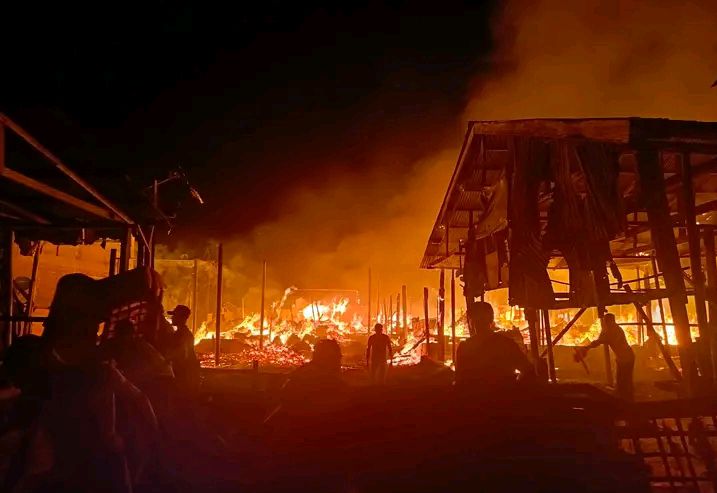
At the Akim Timber Market, darkness surrendered to a fierce orange glow as flames rose and spread like a red tide, swallowing wood, zinc, and years of labour.
Traders who had closed for the day returned to a scene that felt less like a marketplace and more like a furnace without mercy.
“Send down rain, Lord!” a voice pierced through the crackling chaos.
No one asked who spoke. It was the shared cry of business owners watching their livelihoods dissolve into smoke.
One trader, barefoot and frantic, ran toward his stall clutching a plastic bucket. Another shouted directions, pointing helplessly at the advancing flames.
But each splash of water disappeared instantly, like a droplet on a heated tongue.
“We called the fire service,” one victim said, his voice shaking as he struggled to salvage what remained. “They told us they don’t have water.”
For a brief moment, silence hung heavy.
Then the cry rose again, louder, almost defiant:
“Send down rain, Saviour… send down rain!”
A middle-aged man dropped to his knees, hands lifted toward the sky, his voice trembling between faith and frustration.
But beyond the raw emotion lies a deeper concern, one that stretches far beyond the burning stalls of Akim.
A late-night inferno swept through the timber market around 8:00 p.m. on March 27, 2026, destroying shops, planks, roofing sheets, and equipment, while traders battled the flames with buckets of water.
Eyewitness accounts, as cited by Truth Live News, indicate that emergency response was either delayed or ineffective, leaving victims largely to confront the disaster alone for hours.
The fire, according to preliminary accounts from traders on ground, may have originated from a spark on a low-tension electric cable, which ignited nearby sawdust after business hours.
“People around told us it started from an electric spark,” a shop owner who declined to be named explained. “The spark landed on sawdust, and before anyone could react, the fire began spreading.”
Checks at the scene showed that a stretch of low-tension wire, estimated at over 50 metres, had been burnt and collapsed onto the ground.
“When the fire became intense, electricity was taken,” the same source added, suggesting a late response to cut power supply.
For hours, traders formed human chains, carrying buckets of water on their heads in a desperate attempt to contain the blaze.
Each passing vehicle headlight sparked fleeting hope that firefighters had arrived but it was always a false alarm, just more traders rushing in to save whatever they could.
At the time of filing this report, more than two hours after the fire began, no fire service unit had reached the scene.
Only local efforts and the presence of officers of the Nigeria Police Force were observed.
Efforts to reach emergency responders proved abortive.
By the time the flames began to subside, what remained was not just charred wood and twisted metal but lingering questions.
Questions about safety enforcement.
Questions about emergency preparedness.
And questions about a system that appears absent when it matters most.
For many affected traders, the Akim Timber Market is more than a place of business, it is their only source of livelihood.
The destruction threatens not just income, but survival, as families dependent on daily sales now face uncertainty.
The financial cost of the damage has yet to be determined, but traders described losses running into millions of naira, given the volume of timber and materials consumed by the fire.
The impact becomes even more troubling when placed in recent context.
This incident marks the second major fire-related disaster in Calabar within one week, following a gas station explosion in Calabar South that reportedly injured dozens and destroyed properties worth billions.
The pattern raises urgent concerns about fire risk management and urban safety infrastructure in the state capital.
To be sure, authorities have yet to release an official statement outlining the exact cause of the fire or providing a timeline of emergency response.
Systemic challenges, ranging from inadequate equipment to logistical constraints may have contributed to the delayed intervention, even as victims continue to demand accountability.
Still, as dawn broke over the smouldering remains of the market, one image endured.
A man, kneeling in ash, whispering prayers into the ruins.
Because when the fire service has no water, and help does not come, hope, fragile as it may be, becomes the last refuge of those left behind.
Most Viewed Posts
- President Tinubu’s Achievements That Strengthen Case For Second Term – Amuna
- Supporting Siminalayi Fubara: Why Rivers People Deserve Continuity Of Purpose In 2027 – Dr William Omuna
- William Omuna Declares Bid For Rivers East Senate, Says It Deserves Senator Who Shows Up
- Budget Without Representation: Outrage as Senator Natasha Alleges Institutional Marginalisation – By Darlington Okpebholo Ray
- Praying for Survival: Inside Nigeria’s Unchecked Violence Against Christians — By Darlington Okpebholo Ray