

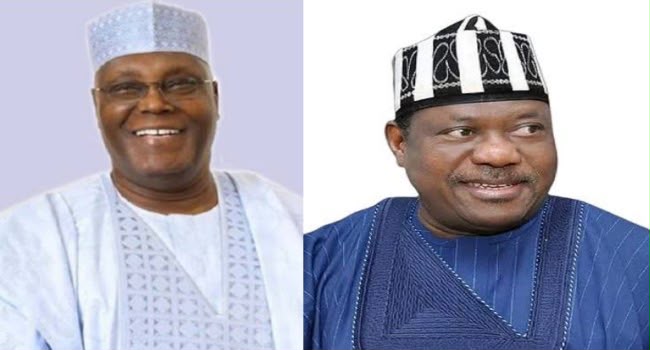
The Secretary to the Government of the Federation, George Akume, has said former Vice President Atiku Abubakar was among the political leaders who supported the adoption of rotational presidency in Nigeria following the annulment of the June 12, 1993 presidential election.
Akume made the remarks on Tuesday, June 9, 2026, during a World Press Conference in Abuja as part of activities marking Nigeria’s 27th Democracy Day anniversary.
According to the SGF, the annulment of the election, widely believed to have been won by the late Chief MKO Abiola, compelled political leaders to make difficult decisions aimed at preserving national unity and strengthening democracy.
A statement by his media aide, Yomi Odunuga, said Akume recalled that leaders of the Peoples Democratic Party met in Kaduna under the leadership of the late Chief Solomon Lar and Alhaji Adamu Ciroma to deliberate on the country’s political future, with power rotation emerging as a key issue during the discussions.
“It was a tough argument before the issue of rotational presidency was agreed upon. At the end, we had to concede. We must do this.
“The June 12 annulment had complicated the whole situation. It was eventually agreed that presidential power should alternate between the North and the South.
“Atiku was one of the leaders at that meeting convened by Chief Solomon Lar. He was part of that agreement,” Akume said.
The SGF explained that the decision to rotate presidential power between the North and South was intended to address the political consequences of the annulled election and promote inclusiveness, equity and national cohesion.
Akume’s comments come amid renewed debate over power rotation ahead of the 2027 general election.
Atiku, a northerner and the presidential candidate of the African Democratic Congress for the 2027 election, is expected to challenge President Bola Tinubu, who is seeking a second term in office.
Tinubu, a southerner, was elected President in 2023 after the completion of the constitutionally permitted two-term tenure of former President Muhammadu Buhari.
Atiku has faced criticism from political opponents and the Presidency for pursuing the presidency during a period when many stakeholders argue that power should remain in the South under the informal rotation arrangement.
Reflecting on the significance of June 12, Akume described the annulment as a painful setback to Nigeria’s democratic aspirations.
“Abiola won that election fairly and squarely. The election was annulled by the military government. It was a painful experience because the people spoke freely and made their choice,” he said.
According to him, one of the major lessons from the June 12 experience is the supremacy of the people’s will in a democratic system.
“The first lesson is that the voice of the people must always be supreme and sacrosanct. That is the essence of democracy. We prefer the ballot to bullets,” he stated.
Akume expressed confidence in Nigeria’s democratic institutions, particularly the Independent National Electoral Commission, saying the country had learned from the events of 1993 and would never permit a repeat of such an annulment.
“If an election is conducted fairly and someone wins, there should be no problem. The officials at INEC are not young people; many of them were adults when this happened.
“If a poll had been conducted then, more than two-thirds of Nigerians would have condemned the annulment,” he said.
The SGF further commended INEC officials, describing them as patriotic and principled individuals committed to safeguarding Nigeria’s democratic process.
“Fortunately for us, those at INEC are men and women of honour and integrity. They are determined to make a difference. Never again will such happen in this country.
“You win, you win. When you lose, go back and prepare for another election. That is the beauty of democracy,” he added.
Akume said Nigeria’s 27 years of uninterrupted democratic rule demonstrated the country’s commitment to democratic governance, the rule of law and civil liberties.
“We have chosen democracy, and for 27 unbroken years we have enjoyed the freedoms it guarantees. There is no system more beautiful than democracy,” he said.
He also highlighted freedom of expression as one of democracy’s greatest strengths.
“It is under a democratic system that you can criticise your leaders and still go to bed without fear of a midnight knock on your door. Try that under a totalitarian regime,” Akume stated.
He urged political actors to uphold democratic values, respect electoral outcomes and continue working towards strengthening Nigeria’s democratic culture.
He added that Nigeria’s 27 years of uninterrupted democracy underscored its commitment to the rule of law, freedom of expression and peaceful political participation.